


Not all the biggest stars in on the silver screen have been actors - some of the most legendary performances have been by four-wheelers.

Cars that became movie stars by being the most desired and expensive automobiles in history

Cars are one of the symbols of the modern world. And they have rightfully taken their place playing key roles in some of the most iconic films. Cars that, just to see them, is to think of a specific film.
And some of those were picked exactly because they were already some of the most desired objects out there.
Here are our favorite cars that transferred their je ne sais quoi to the films they became synonymous with.
DeLorean DMC
For many, the most famous car in cinema history. Not only is it instantly recognizable, with its gull-wing doors and stainless steel body, the addition of the flux capacitor to turn it into a time machine made it a central part of Back to the Future’s plot.
Sadly, without a flux capacitor fitted, the DeLorean was woefully underpowered, and its poor build quality saw demand fail to get off the ground.
The DeLorean company only produced 9,000 of them before going bankrupt in 1982, though there were apparently 6,500 still on the road in 2015.
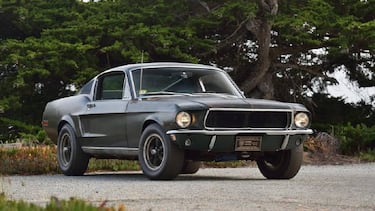
Ford Mustang GT Fastback 390
The Ford Mustang GT Fastback 390 in Highland Green, driven by Steve McQueen in Bullitt (1968), is one of cinema’s classics. A huge 6.4L V8 engine thrashed out 325 hp, allowing the Mustang to shift from 0–60 in just over six seconds, with a top speed of 125 mph.
The groundbreaking 10-minute high-speed chase through the hills of San Francisco went down in cinema history.
Dodge Charger
The Charger is one of the most iconic muscle cars ever built, and has featured in numerous films. In fact, the baddies were driving it when they were pursued by Steve McQueen’s Mustang around San Francisco in Bullitt, and it was the infamous General Lee in The Dukes of Hazzard, which was turned into a film in 2005.
But it’s in The Fast and the Furious where it truly became the star of the show. The movie is easily one of the most influential films in modern car culture, and the original had all the right ingredients: underground street racing, high-stakes drama, and three unforgettable cars. They were a Mitsubishi Eclipse, a Toyota Supra, and the jaw-dropping 1970 Dodge Charger. That beast came packed with a roaring HEMI V8 and a massive supercharger, cranking out a brutal 900 horsepower.
Mini Cooper
The Italian Job (1969) may have had one of the most famous lines in cinema history — “You were only supposed to blow the bloody doors off” — but it also featured one of the most iconic cars ever: the Mini Cooper.
The souped-up version of the lovable small car had famously won the Monte Carlo Rally in 1964, 1965, and 1967 (and was controversially disqualified in 1966 for headlamp irregularities, favoring Citroën), and as a symbol of Cool Britannia — fashionable, fun, and neatly engineered — it took center stage in Michael Caine’s comedy heist romp. The Mini’s agility and stunt potential made it perfect for the chase scenes through Turin: jumps, stair descents, and rooftop drives that still thrill today.
When the Mini was relaunched by BMW in 2001, the new version took pride of place in the third Austin Powers film, Goldmember. It was known as the Shaguar II, a reference to the Shaguar in earlier films which was a…
Jaguar E-Type
When the Jaguar E-Type was unveiled at the Geneva Motor Show, Enzo Ferrari, legendary founder of Ferrari, is said to have breathlessly remarked: “The most beautiful car ever made.” And you can see why, with that long, elegant hood, low-slung, aerodynamic profile, and sleek curves unmatched by many contemporaries — including the Ferraris of the time.
As a ’60s icon, it was perfect for Mike Myers’ Bond spoof.
Volkswagen Beetle
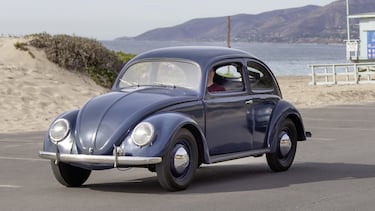
Not all the cars we’ve fallen in love with on the big screen made our hearts flutter through sheer power and muscular lines… but then Herbie wasn’t just a car — he had a personality all his own. The plucky, high-spirited Volkswagen Beetle made his big-screen debut in 1969’s The Love Bug, a Disney hit that turned a humble compact into a pop culture icon. His look was instantly recognizable: white paint, racing stripes in red, white, and blue — a nod to American racing — while his number, 53, is said to be a reference to Don Drysdale, the legendary pitcher with the same number.
Aston Martin DB5
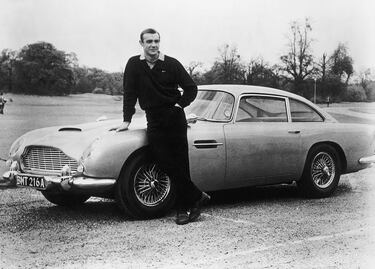
The Aston Martin DB5 might be the suavest car ever to hit the screen, thanks to its association with 007. First appearing in Goldfinger (1964), it was James Bond’s signature ride, fitted of course by Q with, among other gadgets, machine guns, an ejector seat, and tire slashers. The sleek silver grand tourer has appeared in numerous Bond films since, including Skyfall and No Time to Die, and is as much a part of the franchise’s identity as the tuxedo or the martini.
The DB5 Sean Connery drove in Goldfinger and Thunderball sold in 2011 for over $3 million. His own personal DB5 was sold in 2022 for $2.4 million.
Related stories

Get closer to the game! Whether you like your soccer of the European variety or that on this side of the pond, our AS USA app has it all. Dive into live coverage, expert insights, breaking news, exclusive videos, and more. Plus, stay updated on NFL, NBA and all other big sports stories as well as the latest in current affairs and entertainment. Download now for all-access coverage, right at your fingertips – anytime, anywhere.
And there’s more: check out our TikTok and Instagram reels for bite-sized visual takes on all the biggest soccer news and insights.
Complete your personal details to comment