


One of the most famous tracks in film history is almost 60 years old and made this Clint Eastwood western eternal
“The Ecstasy of Gold” is one of the most iconic pieces in the history of cinema. Ennio Morricone immortalized ‘The Good, the Bad and the Ugly’ with his masterful score.
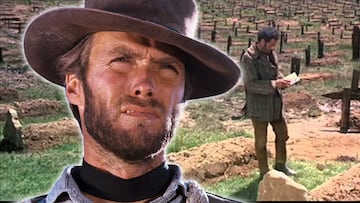
During the 1960s, Clint Eastwood built a reputation as one of the defining figures of the Western genre. The so-called Dollar Trilogy by Sergio Leone, led by The Good, the Bad and the Ugly, established him as one of the great icons of the spaghetti Western.
A decisive factor in that process was Ennio Morricone’s unmistakable music. “The Ecstasy of Gold” is the perfect example. Nearly sixty years later, the composition remains as iconic and evocative as the main theme from Star Wars or the signature music from Indiana Jones.
“The Ecstasy of Gold”: Ennio Morricone’s masterpiece that turned a Spanish cemetery into film history
The sequence featuring “The Ecstasy of Gold” is one of the most intense moments in The Good, the Bad and the Ugly, the legendary film released in 1966. As Tuco, played by Eli Wallach, runs across the vast cemetery of Sad Hill Cemetery in a desperate search for Arch Stanton’s grave, where a fortune in gold is supposedly buried, Morricone unleashes a relentless crescendo that blends voices, percussion, and clean electric guitars to convey the gold fever and the character’s obsession with wealth at any cost.
However, the audience knows the search is futile because the character has been deceived about the grave’s name, by Rubio (Clint Eastwood) and that tragic irony turns the frenzy of the scene into pure cinematic brilliance.
That monumental cemetery was located in Spain, specifically in the province surrounding Burgos. It was built specifically for the production in the Mirandilla Valley near Santo Domingo de Silos. After decades partially buried and forgotten, a group of fans restored it between 2015 and 2016, reconstructing thousands of graves and returning it to its original design.
Today, Sad Hill has become a pilgrimage site for Western fans and one of the most picturesque and visited locations in the region.
No, “The Ecstasy of Gold” is not the music from the final duel in The Good, the Bad and the Ugly
Interestingly, the power of “The Ecstasy of Gold” is so strong that it is often mistaken for the music used in the final duel. In reality, that scene features a different composition, “The Trio” (Il Triello).
The confusion is understandable because Morricone uses similar guitar chords and a gradually escalating structure in both pieces. Each composition, however, serves a different emotional purpose: the feverish urgency of the search versus the solemn, lethal tension of the three-way showdown.
The final duel between Sentencia, played by Lee Van Cleef, Tuco, and Eastwood’s character remains one of the most memorable scenes in the Western genre. Morricone’s score adds immeasurable tension. Killing glances, the decision of whom to shoot, and the precise moment to draw are conveyed with almost no dialogue throughout the sequence.
From Ennio Morricone to Metallica: the legacy of “The Ecstasy of Gold” lives on
The Sad Hill sequence turned “The Ecstasy of Gold” into a classic, but its second life arrived through Metallica. The American band adopted the piece as the fixed introduction to their concerts beginning in the early 1980s, treating it as a ritual.
Their version amplifies the original crescendo with powerful instrumentation while preserving Morricone’s harmonic structure.
Each performance begins with the melody blasting at full volume as the audience erupts in cheers, a moment that has made the composition an inseparable part of the band’s identity. This tradition has helped millions of listeners rediscover the piece outside the context of film, keeping it relevant and more alive than ever.
Ultimately, the score of The Good, the Bad and the Ugly remains a true cinematic benchmark nearly sixty years later. Morricone transformed a Spanish cemetery into a mythical setting and elevated every shot with an elegance that transcends the art of film itself.
His music was not mere accompaniment but an active force in shaping the story’s unique, almost mythological atmosphere. The fusion of imagery and sound, of dust, silence, and guitars, is precisely what made this Western a completely timeless work.
Related stories
Get your game on! Whether you’re into NFL touchdowns, NBA buzzer-beaters, world-class soccer goals, or MLB home runs, our app has it all.
Dive into live coverage, expert insights, breaking news, exclusive videos, and more – plus, stay updated on the latest in current affairs and entertainment. Download now for all-access coverage, right at your fingertips – anytime, anywhere.
Complete your personal details to comment