


The Pearl Jam frontman read a horrific news story in a newspaper and changed the history of rock, but a censorship error turned a suicide into a massacre.

The controversial story of ‘Jeremy’, the song that Eddie Vedder (Pearl Jam) composed after seeing a tragic newspaper clipping
January 1991. Eddie Vedder is having breakfast in a Seattle diner, skimming the crime pages. He could have turned the page, but instead he stops on a tiny clipping. A 15-year-old kid, Jeremy Wade Delle, shot himself in front of his 30 classmates at a Texas high school.
There are no big headlines. Just filler news from small-town America. The note says the boy left his English class at Richardson High School to get a tardy slip. When he returned, he walked up to the teacher’s desk and delivered a line straight out of a horror movie: “Miss, I got what I really went for.” Before anyone could react, he pulled out a .357 Magnum revolver and took his own life.
Vedder did not write a song for teenagers to jump around to at festivals. He wrote the autopsy of a terrible American tragedy. What no one reported at the time was that Jeremy, a gifted artist, was about to be awarded a prize for a drawing of a pack of wolves.
He died without ever knowing it. Success and death crossed paths in a high school hallway.
How censorship rewrote the meaning of ‘Jeremy’
The problem is that the music industry, the same one that claims to trade in emotion, almost never has a soul. Pearl Jam recorded the song with a 12-string Hamer bass because Jeff Ament wanted a metallic sound, a kind of screech that would make your skin crawl before the vocals came in.
But what truly made people’s skin crawl was the MTV video. In a stunning display of hypocrisy, the network censored the ending in which Jeremy puts the gun in his mouth, arguing that showing a suicide could inspire imitation.
The result was disastrous. Everyone assumed the boy had massacred his classmates. In the name of political correctness, a desperate child who took his own life, for reasons still not fully understood, was turned into a mass murderer by a simple cut of the scissors.
This is the original video, without MTV’s censorship.
Brian Jackson, a student who was in the hallway, described it years later, saying that that was a loud bang, a hard thud, “like someone slamming a book against a desk. I thought they were doing a play or something, but then I heard a scream and a blond girl came running out of the classroom and she was crying.”
The confusion fueled the myth, but something broke inside Vedder. At the 1993 VMAs, Pearl Jam swept the award for Best Video of the Year, but the band was already sick of the overexposure and the misunderstanding. Vedder and the band went onstage joined by Trevor Wilson, the star of the ‘Jeremy’ video.
The lead singer of Peral Jam started by saying: “Hey everybody, this is Trevor. He lives.” and then said: “I mean, I guess you’ve gotta say thanks.” He followed by sharing, “If it weren’t for music, I think I would have shot myself in the front of the classroom.”
Consequences of public’s failure to understand Jeremy’s true message
Their response was radical, almost career-ending at the time. Pearl Jam decided stop making traditional music videos. And they followed through, or rather did not, for nearly a decade. They preferred silence to being haunted by the image of a dead child.
But the punishment was not limited to the cameras. After the Columbine massacre in 1999, Pearl Jam felt the world still did not understand anything, and they removed the song from their live shows.
“Jeremy” was locked away until 2003. They only began playing it regularly again when they felt the audience was finally listening to the lyrics, not just the chorus.
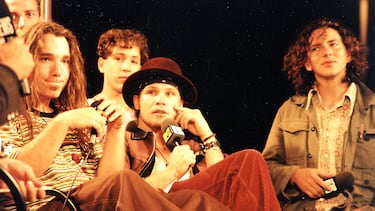
Jeremy was not the only ghost in Vedder’s head. Years earlier, at his own high school in San Diego, a kid named Brian Keedle had fired a gun into the wall of an oceanography lab without hurting anyone. Vedder blended the two boys together in an attempt to understand why a teenager might decide that his only loudspeaker is the thunder of a gunshot.
Wanda Crane, Jeremy’s mother, tired of her son’s name becoming a stadium anthem, telling ABC WFAA: “That day that he died did not define his life.” She has always said she does not recognize him in those lyrics, “I was angry at them for writing that song. I thought, You don’t know. You weren’t there. That story isn’t accurate.”
But no one seems to care. No matter how loudly you scream into a microphone, sometimes reality is far quieter and sadder than a hit song that everyone believes is about a boy who killed his classmates.
Related stories


Get closer to the game! Whether you like your soccer of the European variety or that on this side of the pond, our AS USA app has it all. Dive into live coverage, expert insights, breaking news, exclusive videos, and more. Plus, stay updated on NFL, NBA and all other big sports stories as well as the latest in current affairs and entertainment. Download now for all-access coverage, right at your fingertips – anytime, anywhere.
And there’s more: check out our TikTok and Instagram reels for bite-sized visual takes on all the biggest soccer news and insights.
Complete your personal details to comment