


A group of climbers accidentally discovers a biological phenomenon from 80 million years ago
The discovery of fossilized footprints in Italy has caught the attention of scientists. They may have been formed after an earthquake.
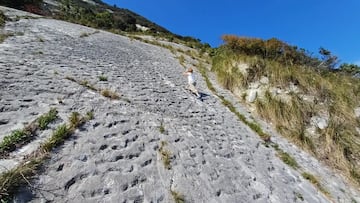

A group of climbers scaling a rocky cliff on Italy’s Mount Conero stumbled onto something extraordinary: fossilized tracks that point to a mass stampede of sea turtles nearly 80 million years ago.
The markings immediately caught their attention because they looked strikingly similar to others found months earlier in the same nature reserve—tracks previously linked to a Cretaceous-era marine reptile.
Realizing they might have uncovered something scientifically significant, the climbers reached out to Paolo Sandroni, a geologist who also happens to be an avid climber. Sandroni then contacted Alessandro Montanari, director of the Coldigioco Geological Observatory (OGC), who organized a full investigation with a team of researchers.
Their findings were published in Cretaceous Research in November 2025. The tracks were embedded in a layer of Scaglia Rossa limestone, a well‑known geological formation that preserves millions of years of deep‑sea sediment.
A prehistoric earthquake frozen in time
Montanari explained that what is now a mountain ridge was once the floor of an ancient ocean. Rock analysis shows the limestone formed roughly 79 million years ago, during the Cretaceous period, and was sealed beneath a sudden underwater mudslide triggered by an earthquake.
That seismic explanation is backed by decades of earlier research. Under the microscope, the rocks contain microfossils from organisms that lived in deep water. Under normal conditions, any animal tracks would have been erased quickly by ocean currents—but the earthquake‑driven mud avalanche buried them fast enough to preserve them.
The research team believes the only vertebrates capable of leaving such marks would have been marine reptiles like sea turtles. Not everyone in the scientific community is convinced, though. Paleontologist Michael Benton agrees the geological setting is well documented but questions which animal actually made the tracks.
Montanari stresses that the site needs further study and hopes the discovery will spark new research into this mysterious moment in Earth’s history.
Related stories
Get your game on! Whether you’re into NFL touchdowns, NBA buzzer-beaters, world-class soccer goals, or MLB home runs, our app has it all.
Dive into live coverage, expert insights, breaking news, exclusive videos, and more – plus, stay updated on the latest in current affairs and entertainment. Download now for all-access coverage, right at your fingertips – anytime, anywhere.
Complete your personal details to comment