


A village hidden for centuries underground has been discovered after a 2,000-year-old Roman clock was found
The presence of this historical artifact reveals the presence of past settlements in the province of Sinop, Turkey.
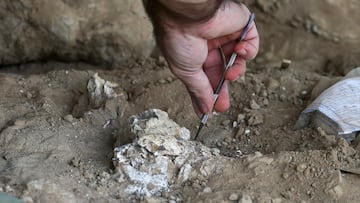
A new archaeological discovery has surprised the scientific community. In the small village of Yenigüler, in the province of Sinop, Turkey, several pre-Ottoman artifacts have been uncovered. The find happened almost by chance, after the discovery of a Roman sundial carved from marble and preserved in excellent condition. Further investigation revealed evidence of an ancient settlement.
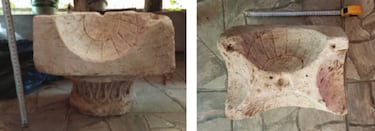
Various objects from the Roman and Byzantine periods were found scattered across the forested landscape surrounding the village. The standout piece was the aforementioned sundial, dated between the 1st and 3rd centuries. According to a study published by TYB Akademi, this object is of great importance to the region and is considered the most significant discovery to date.
The sundial is far from an ordinary find. It provides the clearest evidence yet that the area once had a substantial pre-Ottoman presence, challenging previous assumptions. As a result, it reshapes the historical narrative of the site. According to the study’s authors, the sundial must have been brought from another location, as it is not native to the region. The absence of a suitable marble quarry in the area supports this hypothesis.
The artifact measures approximately 11 by 13 inches and rests on a circular pedestal about 6 inches high. Its front features leaf designs, while the back has the shape of an inverted pyramid. Although its corners are damaged, partial remains of metal fragments secured with lead are still visible. The only component that did not survive the passage of time is the gnomon, the vertical piece responsible for casting the shadow used to tell time.
Tiles, bricks, and more
Interest in the site predates the discovery of the sundial. In September 2024, shortly after a construction project began in the area, several architectural elements of historical significance were unearthed, including terracotta tiles, brick fragments, ceramics, and building stones, many of which date back to the Byzantine period.
The discovery sparked intense activity among so-called treasure hunters, who quickly flocked to the site. According to the study’s authors, the settlement area “is being rapidly destroyed by treasure hunters every day.” Subsequent investigations indicate that the settlement maintained a significant presence during both the Roman and Byzantine periods.
Related stories
Get closer to the game! Whether you like your soccer of the European variety or that on this side of the pond, our AS USA app has it all. Dive into live coverage, expert insights, breaking news, exclusive videos, and more. Plus, stay updated on NFL, NBA and all other big sports stories as well as the latest in current affairs and entertainment. Download now for all-access coverage, right at your fingertips – anytime, anywhere.
And there’s more: check out our TikTok and Instagram reels for bite-sized visual takes on all the biggest soccer news and insights.
Complete your personal details to comment