


Alarm and uncertainty among scientists after hundreds of earthquakes detected in the Doomsday Glacier
Earthquakes recorded under the Thwaites Glacier reveal processes of fracturing and sliding of the ice over the Antarctic bedrock.
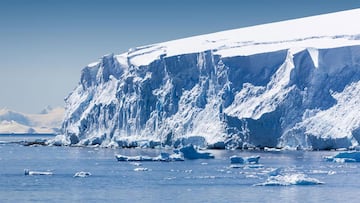
A wave of alarm and uncertainty is rippling through the scientific community after researchers detected hundreds of small earthquakes beneath Antarctica’s Thwaites Glacier, ominously nicknamed the “Doomsday Glacier.”
The seismic signals, recorded deep under the ice, point to fracturing and sudden slipping within the glacier itself, offering a rare—and troubling—look at the hidden mechanics of one of the most critical ice formations on the planet.
Why the Thwaites Glacier matters so much
Thwaites is one of the largest glaciers in West Antarctica and already plays an outsized role in global sea-level rise. Scientists estimate it is currently responsible for about 4% of the world’s sea-level increase, shedding roughly 50 billion tons of ice every year.
What makes it especially dangerous is its position. Thwaites acts like a cork, holding back massive inland ice sheets. If it destabilizes, it could unleash far more ice into the ocean.
🛰️Sentinel-1 monitoring Antarctica
— Sérgio OSMsmaprs (@sergioajv1) December 10, 2025
Thwaites Ice Shelf, 2017-2025 timelapse.
One of the biggest ice shelves in West Antarctica, though it is highly unstable and disintegrating rapidly.
➡️ https://t.co/8wAV4G4yiz
Sentinel-1 EW @CopernicusEU https://t.co/9dujF9ZieQ pic.twitter.com/dXW4Fzfoe8
Earthquakes that aren’t tectonic—but still dangerous
According to researchers, these earthquakes are not caused by Earth’s tectonic plates. Instead, they result from the glacier’s own internal movement.
Data shows episodes where the ice suddenly slides over the rocky bed beneath it, a process known as “stick-slip.” In this phenomenon, tension builds up as the glacier resists movement, then releases abruptly, causing jerky advances rather than smooth flow.
Each of these slips generates seismic waves—essentially icequakes—now being picked up by sensitive instruments.
Thwaites ‘Doomsday’ Glacier Is ‘Hanging on by its Fingernails’
— GO GREEN (@ECOWARRIORSS) January 14, 2024
Its a slab of ice the size of Florida in Antarctica, is hanging on by the skin of its teeth
If it collapses entirely, researchers believe it could raise global sea levels by up to 10 feet.https://t.co/2uqkT7mI3O pic.twitter.com/yK3o2upE6r
The warming ocean factor
Many of the earthquakes are concentrated where the glacier meets the ocean, a zone particularly vulnerable to rising seawater temperatures.
Scientists explain that warmer ocean water weakens the glacier’s base, making it easier for the ice to slide and fracture. That instability produces the bursts of seismic activity detected beneath Thwaites.
Importantly, this activity happens in clusters, not continuously. The glacier alternates between quiet periods and sudden phases of accelerated movement—an unsettling pattern for researchers trying to predict future behavior.
Could Thwaites trigger meters of sea-level rise?
If Thwaites were to collapse completely, scientists warn it could contribute up to 10 feet (around 3 meters) to global sea levels over time. That scenario would dramatically reshape coastlines worldwide.
Researchers stress that the current findings do not signal an imminent collapse. However, they do confirm that the glacier is undergoing complex, dynamic changes that demand close monitoring.
The newly collected data will help refine long-term climate and sea-level models. Still, recent studies suggest that even a 20-inch (50-centimeter) rise in sea level could flood three million buildings in the Southern Hemisphere alone—a stark reminder of what’s at stake.
Related stories
Get your game on! Whether you’re into NFL touchdowns, NBA buzzer-beaters, world-class soccer goals, or MLB home runs, our app has it all.
Dive into live coverage, expert insights, breaking news, exclusive videos, and more – plus, stay updated on the latest in current affairs and entertainment. Download now for all-access coverage, right at your fingertips – anytime, anywhere.
Complete your personal details to comment