


Albert Einstein, scientist: “Two things are infinite: human stupidity and the universe; and I’m not really sure about the latter”
The German physicist revolutionized modern science and became a critical voice on the ethical responsibility of scientific knowledge.
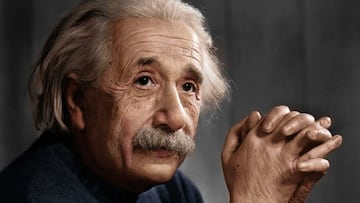
Albert Einstein was one of the most important and influential scientists of the twentieth century, and indeed in all of history. His work has helped generations of today’s astronomers and physicists, and he will always be remembered not only for his scientific contributions, but also as a major intellectual reference.
Of Jewish origin, Einstein was a key figure in the history of modern physics. Born in Ulm, Germany, in 1879, he stood out not only for his scientific brilliance, but also for his critical thinking, social commitment, and ability to communicate complex ideas in accessible language.
Einstein developed the theory of relativity, which profoundly transformed the understanding of space, time, and energy. His famous equation, E = mc², established the equivalence between mass and energy. In 1921, he received the Nobel Prize in Physics, not for relativity, but for his explanation of the photoelectric effect, a discovery fundamental to the development of quantum physics.
Did you know we can thank physics laureate Albert Einstein, in part, for our smartphone cameras?
— The Nobel Prize (@NobelPrize) September 28, 2025
You probably know him best for his theory of relativity, but he actually was awarded the 1921 physics prize for explaining one of light’s weirdest behaviours: the photoelectric… pic.twitter.com/vOf5aGGbXj
A scientist committed to society
Beyond his academic achievements, Einstein was an active public figure. He advocated for pacifism, civil rights, and intellectual freedom. With the rise of Nazism in Germany, he emigrated to the United States in 1933, where he worked at the Institute for Advanced Study in Princeton. From there, he warned of the dangers of totalitarianism and took part in ethical debates surrounding the use of science.
Although he considered himself a “convinced pacifist,” in 1939 he indirectly contributed to the development of nuclear energy. Einstein signed a letter warning President Roosevelt about the potential military use of this technology by Nazi Germany. After the end of World War II and the use of the atomic bomb, Einstein expressed deep regret and strengthened his commitment to disarmament and the ethical oversight of science.
Einstein also stood out for his humanist perspective. His reflections on the human condition, education, and the social responsibility of scientists made him a respected intellectual far beyond the scientific community. Quotes like the one that opens this article, “Two things are infinite: human stupidity and the universe; and I am not really sure about the latter,” reflect his critical outlook and his irony in the face of human limitations.
Albert Einstein died in 1955 at the age of 76, but his legacy remains alive. His theories continue to be fundamental to contemporary scientific research, and his figure still symbolizes curiosity, free thought, and a commitment to knowledge in the service of humanity.
Related stories
Get your game on! Whether you’re into NFL touchdowns, NBA buzzer-beaters, world-class soccer goals, or MLB home runs, our app has it all.
Dive into live coverage, expert insights, breaking news, exclusive videos, and more – plus, stay updated on the latest in current affairs and entertainment. Download now for all-access coverage, right at your fingertips – anytime, anywhere.
Complete your personal details to comment