


Albert Szent-Györgyi, Nobel laureate: “Every morning, without fail, I get up before dawn and run 3 kilometers, regardless of my mood or the weather”
The physician, born in Budapest at the end of the nineteenth century, was wounded in the Great War and targeted by Hitler during World War II.
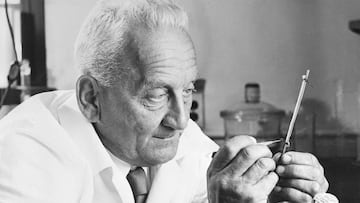
Albert Szent-Györgyi, awarded the Nobel Prize in Medicine in 1937 for his discovery of vitamin C, was far more than a physician and scientist. Born in Budapest at the close of the nineteenth century, he experienced firsthand the devastation of both World War I and World War II.
During the Great War, he was wounded after shooting himself in order to escape the front lines. In World War II, Hitler ordered his arrest after learning that he was secretly negotiating with the Allies.
Szent-Györgyi’s relentless search for Vitamin C
Even while risking his life to secure a truce that could end the deaths of millions across Europe, Szent-Györgyi never abandoned his work as a physician. Just before the outbreak of World War II, around 1928, he was at the University of Cambridge trying to understand cellular oxidation. He believed that hexuronic acid could prevent scurvy, but he did not have enough of the substance to begin animal testing.
It was not until four years later, back in Hungary, that he and researcher J. L. Svirbely conducted studies using guinea pigs. Some were not given the acid and developed scurvy, while others received it and remained healthy. This allowed them to conclude that vitamin C and hexuronic acid were one and the same.
One of the crown jewels of Hungarian cuisine, paprika, played a crucial role in expanding and deepening his theories. One evening, his wife prepared peppers for dinner, but he took them to the laboratory instead. Working with them, he managed to isolate a kilogram of pure vitamin C crystals and, as a result, determine its chemical structure. He renamed it ascorbic acid.
Can you guess what this picture is? It's an image of Vitamin C, taken with polarised light.
— The Nobel Prize (@NobelPrize) March 19, 2024
Vitamin C led to both the 1937 medicine and chemistry prizes: to Albert von Szent-Györgyi, who first isolated it, and Norman Haworth for determining its molecular structure. pic.twitter.com/AMpZ4wtGqn
Vitamins important role in the body
Unlike proteins or fats, vitamins are catalysts. That is, they speed up metabolic chemical reactions in the body without being consumed in the process.
“A vitamin is a substance that makes you ill if you don’t eat it,” the physician argued. Its absence brings cellular machinery to a halt, as seen in diets heavy in ultra-processed foods that lack essential micronutrients. “Health is not about not being hungry, but about every enzyme having its vitamin in order to function.”
Physical exercise “regardless of mood or the weather” was key to long life
Szent-Györgyi died in 1986 at the age of 93. He remained remarkably lucid until his final days, not thanks to vitamin C, as he himself said, but because of his constant physical activity. In the United States, where he went into exile after fleeing the Soviet occupation of Hungary, he practiced all kinds of sports, both on land and at sea.
One of his most famous quotes reflects this philosophy: “Every morning, without fail, I sluggishly rise before the sunrise and jog three kilometers, regardless of my mood or the weather.”
The Hungarian scientist understood that exercise regulates mood and should not be done only when one already feels well. He also had an advantage, since he knew that running activated proteins in much the same way that an electric bicycle goes faster the more you pedal.
Related stories
Get your game on! Whether you’re into NFL touchdowns, NBA buzzer-beaters, world-class soccer goals, or MLB home runs, our app has it all.
Dive into live coverage, expert insights, breaking news, exclusive videos, and more – plus, stay updated on the latest in current affairs and entertainment. Download now for all-access coverage, right at your fingertips – anytime, anywhere.
Complete your personal details to comment