


Alejandro Martínez Rico, psychiatrist: “It’s like taking a train straight to depression”
The psychiatrist and science communicator analyzes for AS how anxiety affects us, how fears can be deactivated, and how to learn to manage emotions.
Living with less anxiety in today’s society is not easy, but it is not an impossible dream either. For psychiatrist Alejandro Martínez Rico, it is one of the great challenges of our time.
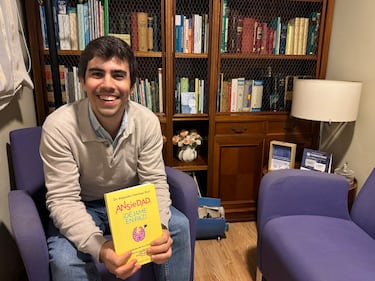
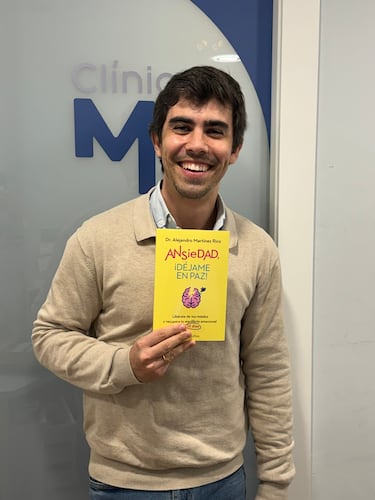
“Anxiety is the invisible tax we pay for living in a frantic society that often pushes us to the point of becoming ill and mentally blocked,” he warns in an interview with AS on the occasion of the publication of his book ‘Ansiedad, ¡déjame en paz!’ (Anxiety, Leave Me Alone!).
Although the term has become popular and more and more people say they “have anxiety,” the specialist reminds us that it is not always well understood. “We all experience anxiety and stress at many moments in our lives. The problem arises when it becomes chronic or when the intensity is too high,” he explains.
In his practice, he often uses a very vivid metaphor: “It’s like a smoke detector in the kitchen. It can save your life if there’s a fire, but if it goes off all the time, it makes your life unbearable.”
Anxiety itself, he insists, is not inherently negative. “We need it to perform at our best during an exam or a presentation,” he notes. The problem appears when the body lives in a constant state of alert. “If I live like that every day of my life, it’s extremely harmful.”
“The illness with a thousand faces”
One of the greatest risks of anxiety is its ability to disguise itself. Martínez Rico defines it as “the illness with a thousand faces” and admits that many patients are surprised when they discover how far it can reach. “From dizziness, palpitations, chest tightness, or a feeling of shortness of breath, to frequent forgetfulness, poor performance at work, or terrible physical pain. Almost anything you can imagine can have anxiety behind it.”
These physical manifestations are no coincidence. “It’s your body’s way of telling you, ‘I can’t take this anymore. We can’t keep up this pace,’” he explains. He also issues a clear warning: “Living at a thousand revolutions per minute comes at a cost.”
In fact, if it is not addressed in time, the path can be dangerous. “Anxiety is like getting on a train headed for depression. If you don’t get off earlier, your body will force you to stop.”
Occasional stress versus constant anxiety
The psychiatrist distinguishes between occasional stress and persistent anxiety. “Stress is a response to a specific event,” he explains, comparable to a spike in cortisol that allows us to react to an emergency.
Problematic anxiety, on the other hand, takes hold when there is “constant anticipatory and catastrophic thinking: something will go wrong, I’ll embarrass myself, something terrible is going to happen.” That is when, he emphasizes, “there is something that needs to change.”
A silent epidemic
Martínez Rico has no doubts when asked whether we are more anxious today than a few decades ago. “Yes, and the data confirms it,” he says. “Anxiety is the most common mental health condition in the world, and its incidence keeps increasing year after year.”
In his view, this forces us to ask “what we are managing so poorly in our daily lives that we feel we can’t keep up with everything.”
The causes are many. “It depends on the biopsychosocial model: genetics, personality, upbringing, perfectionism, self-demand, difficulty delegating. Every person is different,” he explains. That is why he stresses the importance of identifying what fuels anxiety in each individual case.
Small changes with a big impact
Among the most effective tools, the psychiatrist highlights physical exercise. “We have meta-analyses showing that doing moderate exercise three times a week, for about 50 minutes, can have a stronger antidepressant and anti-anxiety effect than the best medication,” he says. He also regrets that its impact on mental health is still underestimated.
He also emphasizes breathing. “It’s that emergency and calming button we all carry with us. It’s free and we can activate it at any time,” he explains. “With two or three diaphragmatic breaths, you can achieve a sense of calm exactly when you need it most.”
Although many cases can improve without medication, Martínez Rico remains cautious. “Every case is different,” he says. Still, he acknowledges a problem in Spain: “We are world champions in prescribing benzodiazepines.”
He reminds us that the World Health Organization recommends not taking them for more than two months and warns about prolonged use. “They create tolerance and dependence, just like alcohol.”
Asking for help is not a failure
For those who feel overwhelmed, the first step is clear: “Acknowledging it.”
“I’ve never met a superhero who can handle everything,” he says. Talking about it with those around you and, if necessary, seeking professional help is essential.
As for the shame some people feel about asking for help, the psychiatrist believes something has changed. “If the pandemic brought us anything good, it’s that we’ve normalized the fact that we need help.”
He speaks from personal experience: “Even doctors suffer from anxiety. Life is complex, and there’s nothing wrong with saying: I need someone to give me guidance so I can regain my emotional balance.”
Related stories
Get your game on! Whether you’re into NFL touchdowns, NBA buzzer-beaters, world-class soccer goals, or MLB home runs, our app has it all.
Dive into live coverage, expert insights, breaking news, exclusive videos, and more – plus, stay updated on the latest in current affairs and entertainment. Download now for all-access coverage, right at your fingertips – anytime, anywhere.
Complete your personal details to comment