


Alex Honnold, free solo climber, on how he overcomes fear: “It’s an ever-present part of climbing”
The world-famous free solo climber’s death-defying ascents can cause vertigo and nausea for those that dare to watch. So how does he keep his calm?
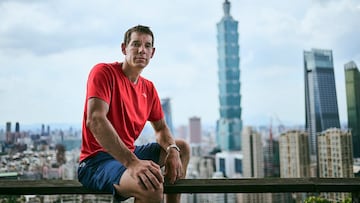
World-famous free solo climber Alex Honnold has been climbing since he was 10 years old and since then he has dared to scale some of the most difficult rock faces there are, achieving feats that no one else ever has. However, speaking with The Talks Honnold recognizes that he’s been the first because “nobody else is really playing the game,” sharing that there aren’t a lot of free solo climbers around.
That doesn’t take away though from his accomplishments like his scaling the 3,000-foot ascent of Yosemite National Park’s El Capitan with no ropes, just his hands, feet and chalk. That feat was documented in the 2018 National Geographic film Free Solo.
This evening, he will be attempting “the biggest urban free-solo climb ever” when he shimmies up the Taipei 101 skyscraper with no ropes or safety nets, which will stream live on Netflix starting at 8 pm ET. The building is roughly 1,667 feet tall, and the surface is made of glass and steel, which he admitted to The New York Times in an interview is “slippery,” but added “you hold on tight.”
This latest death-defying ascent, like his others, is sure to cause vertigo, perhaps some nausea, of those who dare to watch and will definitely make the their hearts race. So how does he keep his calm when the slightest mistake could certainly be fatal?
“I think I’ve gotten used to fear over the years”
In the trailer to the Netflix special, Honnold explains that “I think I’ve gotten used to fear over the years. It’s an ever-present part of climbing.” He conscious of the consequences of losing his grip while crawling up the building saying: “If you fall you’re gonna die.”
However, he has been preparing for the past three months and has climbed the building “two or three times,” but each of those with ropes he told the Times. Even so, “no matter how much you prepare occasionally things just happen,” he says.
“I’m still doing my very best to not die”
“I’ve always been afraid of death,” he told The Talks, but added, “I’ve never wanted to die.”
According to a functional MRI scan he let doctors perform on him in 2016, his brain processes fear differently than other people. While Honnold didn’t consider it “exactly rigorous science” he felt that the results reflected that “through lots of exposure, I’d sort of desensitized myself to certain kinds of stimulus, which makes total sense.”
He shared with the outlet that in 2018 he witnessed a person fall to their death at Red Rock who had all the gear that makes climbing safer sport today than in the past. “It was a reminder of how dangerous climbing can be if things go wrong even when you have all the ropes on,” he reflected.
“You try to learn from accidents that happen. You try to take some kind of lesson from it, but ultimately you’re still always doing your absolute best to not die in an accident,” he explained. “I probably have a more nuanced relationship with death now because I’ve thought about it a lot more. I’ve talked about death a lot more since appearing in the documentary, Free Solo.”
Since that interview in 2019, Honnold married wife Sanni and they’ve become parents to two young girls, both under the age of four, Alice and June. However, he told the Times, “honestly, I don’t think the calculus has changed that much. Because I never wanted to die.”
He explained that that is the reason he puts so much time and effort into preparing and training for a climb. “I have more to live for, and, yeah, I have more to live for, and I’m still doing my very best to not die,” Honnold said.
Related stories
Get your game on! Whether you’re into NFL touchdowns, NBA buzzer-beaters, world-class soccer goals, or MLB home runs, our app has it all.
Dive into live coverage, expert insights, breaking news, exclusive videos, and more – plus, stay updated on the latest in current affairs and entertainment. Download now for all-access coverage, right at your fingertips – anytime, anywhere.
Complete your personal details to comment