


Animal remains discovered by archaeologists who stumble upon a bone that could date back to Hannibal’s war against Rome
The bone represents the first piece of direct material evidence that could link Hispania to the war elephants used by Hannibal.
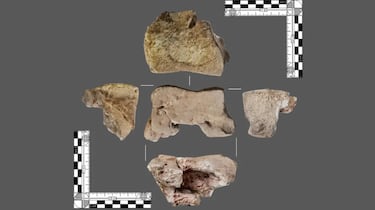
A recent study published in Live Science reports an extraordinary discovery near Córdoba: a 2,200-year-old elephant bone that may be connected to the war elephants deployed by Hannibal during the Second Punic War. The fragment, about the size of a baseball, was found in 2019 at an ancient fortified settlement and has been identified as a right carpal bone, part of the animal’s ankle. Until now, no direct archaeological evidence of these animals had been found beyond historical accounts or environmental traces.
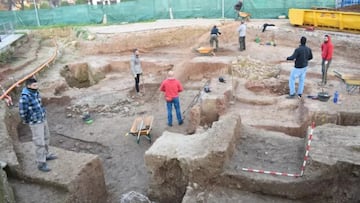
Researchers explain that the bone does not belong to any species native to the Iberian Peninsula. The context in which it was discovered, an oppidum, fortified villages used by the ancient Celts that inhabited the Iberian Peninsula, containing remains dated to around 2,250 years ago, points to a military episode predating the Roman conquest. This hypothesis aligns with historical records documenting the presence of Carthaginian troops and war elephants in the region during Hannibal’s campaigns.
The key role of Spanish researcher Rafael Martínez Sánchez
The leading scientific figure behind the discovery is Rafael Martínez Sánchez, an archaeologist at the University of Córdoba and the study’s lead author. He describes the find as “a landmark” and emphasizes its significance: “there has been no direct archaeological testimony for the use of these animals.”
Martínez Sánchez, who led the anatomical and contextual analysis of the bone, stresses that this discovery opens a new path toward understanding the actual movement of Carthaginian armies across the peninsula and the logistical scale of their war against Rome. His call to the scientific community focuses on two main areas:
- Reassessing the Carthaginian presence in southern Iberia. Martínez encourages a systematic review of other Iberian archaeological sites that may contain, until now unnoticed, remains linked to exotic fauna used in military campaigns. He warns that extremely fragmented or difficult-to-classify remains may have gone overlooked for decades.
- Expanding excavation and conservation efforts in Córdoba. He notes that the oppidum, where the bone was found, despite its strategic importance during the Iron Age, remains poorly understood. He calls for longer excavation campaigns, greater investment, and multidisciplinary teams to fully reconstruct the military episode.
Why this is an extraordinary find
- It is the first piece of direct material evidence that could link Hispania to the war elephants used by Hannibal.
- The bone was preserved because it became trapped beneath a collapsed wall, which explains why the rest of the skeleton did not survive.
- It strengthens the case for a Carthaginian military confrontation in the area, where catapult projectiles and other weapons have also been found.
This discovery provides a unique piece of the puzzle for reconstructing how Carthaginian armies operated in the Iberian Peninsula. Above all, it highlights the central role of Córdoba-based researcher Rafael Martínez Sánchez, whose work has become a key scientific reference for interpreting what may be the first physical trace of the elephants that helped shape Mediterranean history.
The bone, roughly the size of a baseball, was found near the city of Córdoba in Andalusia and could be the only direct evidence of the war elephants used by the Carthaginian general. Historical sources indicate that 37 of these animals accompanied Hannibal and his army across Iberia, over the Pyrenees into southern Gaul, and later across the Alps and into Italy to attack Rome.
Related stories
Get your game on! Whether you’re into NFL touchdowns, NBA buzzer-beaters, world-class soccer goals, or MLB home runs, our app has it all.
Dive into live coverage, expert insights, breaking news, exclusive videos, and more – plus, stay updated on the latest in current affairs and entertainment. Download now for all-access coverage, right at your fingertips – anytime, anywhere.
Complete your personal details to comment