


Archaeologists laugh off conspiracy theorists’ alternative takes about the world’s oldest temple shared on Joe Rogan’s podcast
Archaeologists dismiss Joe Rogan’s guests’ claims of a lost Ice Age civilization behind Göbekli Tepe, pointing to clear local origins.
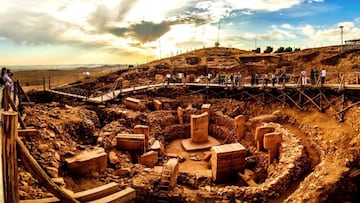

Göbekli Tepe, in Turkey, is a temple dating back nearly 12,000 years. Located about 25 miles from the Turkish-Syrian border on the Urfa plain, it’s a fascinating archaeological site, with large circular structures containing huge limestone pillars decorated with wild animals such as lions, foxes, boars, scorpions, and birds, along with human arms and hands.
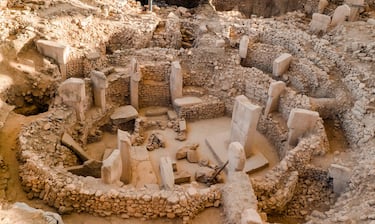
This far back in human history, archaeologists are still piecing together exactly what the temple and the carvings at the UNESCO World Heritage site mean. Experts admit they are still working on their hypotheses about the site’s intended purpose.
There is consensus that Göbekli Tepe was built by local Pre-Pottery Neolithic peoples. However, there is debate because the site was built at the end of the last Ice Age, at the start of the Neolithic period in Southwest Asia, where the first permanent human settlements appeared.
Farming began to appear around this time, but a key question remaining to be answered is whether agriculture caused people to settle down, or whether people who had settled down then discovered agriculture.
Outlandish theories about Göbekli Tepe
Where there is debate in archaeology is often where conspiracy theorists come in, bringing with them wild speculation and outlandish theories.
Given how old it is, Göbekli Tepe is a prime candidate for such theories. British author Graham Hancock claims, without empirical evidence, that there was a lost civilization predating the Ice Age, which was destroyed but managed to transfer technology to the people who built Göbekli Tepe. This theory has been widely debunked by experts, although Netflix aired a controversial take on it in Ancient Apocalypse, which was highly criticized by professional archaeologists.
Archaeologists reject Hancock’s conclusion because the evidence doesn’t require a vanished Ice Age civilization to explain Göbekli Tepe. The skills, planning, and architectural styles on display there can be traced back step by step through earlier Natufian and Late Epipalaeolithic sites, showing a local evolution over thousands of years. Climate shifts certainly shaped human settlement, but they don’t prove an outside culture arrived with ready-made technology. In short, what Hancock sees as a mysterious “jump” looks to archaeologists like the predictable result of steady innovation by the same communities already living in the region.
Such theories have been given further mainstream attention by Joe Rogan’s popular podcast, which regularly gives airtime to alternative takes on science, history, and archaeology.
In November last year, another Göbekli Tepe conspiracy theorist, Jimmy Corsetti, appeared on Rogan’s show and accused the archaeologists digging at the site of deliberately working slowly and hiding discoveries they had made.
The excavations at the site began in the 1990s, and so far only a small proportion of the entire site has been uncovered.
Archaeologists debunk claims on Rogan’s podcast
An actual archaeologist investigating the site spoke to NPR recently to laugh off the conspiracy theories. Dr. Lee Clare, a researcher with the German Archaeological Institute, explained why the digging is taking so long: “You can’t just bulldoze a site to get everything out. That’s the wrong approach.”
As he explained, you need to truly understand each layer as you dig through it, because once you have gone through it, it’s gone for good.
Sadly, he says the attacks from conspiracy theorists have led to him deleting his social media accounts.
What does Göbekli Tepe prove?
In Clare’s view, the site at Göbekli Tepe proves that humans have been storytellers for at least 12,000 years. In his opinion, the carvings on the pillars are all stories, though we don’t yet know what they say.
What we don’t need is to invent some fantastic story about a lost civilization — the people who built Göbekli Tepe are fascinating enough in their own right.
Related stories
Get your game on! Whether you’re into NFL touchdowns, NBA buzzer-beaters, world-class soccer goals, or MLB home runs, our app has it all.
Dive into live coverage, expert insights, breaking news, exclusive videos, and more – plus, stay updated on the latest in current affairs and entertainment. Download now for all-access coverage, right at your fingertips – anytime, anywhere.
Complete your personal details to comment