


Bones of a 140,000-year-old child could rewrite human-Neanderthal history
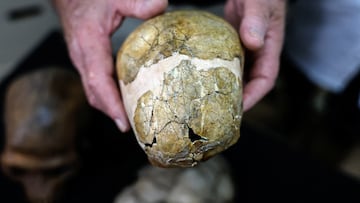
Discovered in 1931, the bones of a child unearthed didn’t look precisely like those of a Homo sapien nor a Neanderthal. New research has unveiled why.

The common belief used to be that Homo sapiens and Neanderthals never interbred. However, with the advent of DNA mapping it became apparent that that was not the case and today most humans have genes that are between 1% and 4% of Neanderthal origin.
But exactly when Homo sapiens and Neanderthals began interbreeding was somewhat of a mystery. The earliest evidence of this occurring until now has been that they started mixing in Central Europe around 40,000 years ago. However, new research may push that date back by 100,000 years.
Monkey business: Homo sapiens and Neanderthals interbred earlier than thought
The evidence for this much earlier than thought potential interbreeding comes from detailed analysis using CT scans of the cranium of a child found in a cave on Mount Carmel in what is today Israel. Some 140,000 years ago ancient humans and Neanderthals intentionally buried their dead there, some of the oldest known examples of the practice in the world.
Researchers explained in a study, published in the journal L’Anthropologie, that they were able to create virtual 3D models of the child’s fossils found in Skhul Cave in 1931 that allowed them to see details that weren’t visible to the naked eye. They were able to see the small imprints of blood vessels, for example, inside the skull, the pattern of which is different for both Homo sapiens and Neanderthals due to their different brain shapes.
The analysis of those structures, along with other features of the cranium and jaw, led them to conclude that the child was a hybrid of the two species and not some form of modern human as had been categorized until now. Unfortunately, no DNA has been recovered from the fossils that could definitively determine the child’s origins.
Homo sapiens: replaced Neanderthals with love, not war
Homo sapiens and Neanderthals co-existed for a long period of time after the former left Africa around 200,000 years ago. They first encountered populations of the latter in the Levant, the land bridge to Asia and Europe where Neanderthals first appeared about 400,000 years ago.
Neanderthals eventually died out roughly 40,000 years ago, an outcome attributed by many to Homo sapiens completely eliminating their competitor explained Israel Hershkovitz, a professor of archaeology and human evolution at Tel Aviv University and the lead researcher of the recent study.
Theory has is that these interactions were hostile and violent, but he says the fact that they were interbreeding as well as sharing similar culture and tool making practices tell a different story. While he admitted to the Associated Press that modern humans exhibit aggressive behavior, he says that that “is a recent phenomenon that has cultural roots and not biological roots.”
“What Skhul is telling us is that Homo sapiens are not a vicious, aggressive creature, but one that managed to live in peace,” he reflected.
Related stories
Get your game on! Whether you’re into NFL touchdowns, NBA buzzer-beaters, world-class soccer goals, or MLB home runs, our app has it all.
Dive into live coverage, expert insights, breaking news, exclusive videos, and more – plus, stay updated on the latest in current affairs and entertainment. Download now for all-access coverage, right at your fingertips – anytime, anywhere.
Complete your personal details to comment