


Divers stumble upon a venomous sea creature—and its name holds a touching secret
A bizarre new species discovered off Spain’s coast is deadly, accordion-shaped... and named after someone’s true love.
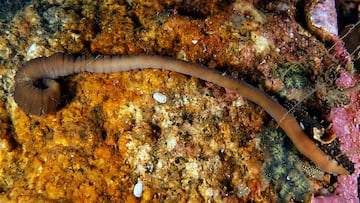
In the cold, mysterious waters off Galicia in northwestern Spain, scientists have discovered a creature like no other—deadly, strange, and deeply personal.
It’s called Pararosa vigarae, and while it may only stretch to 10 inches (25 cm) when fully extended, this venomous marine worm has already captured the attention of biologists around the world. The find, recently published in the journal Royal Society Open Science, was led by Dr. Aida Verdes of Spain’s National Museum of Natural Sciences.
What makes this new species so extraordinary isn’t just its toxic hunting style or its unusual ability to contract like an accordion—it’s also the touching reason behind its name.
A shape-shifting predator with a one-of-a-kind twist
Pararosa vigarae belongs to the phylum Nemertea, a group of ribbon-like marine worms known for ambush hunting and for producing chemical toxins that paralyze prey. But this species stands out for more than its lethal toolkit.
Even when fully stretched, its segmented rings remain clearly visible—a defining characteristic that helps distinguish it from its close relatives.
According to Dr. Verdes, the worm contracts into a set of tight, symmetrical rings, collapsing down to barely a fifth of its total length.
(HILO) 🧵 'Pararosa vigarae' es el nombre de la nueva especie de gusano 🪱 descrita por un equipo de investigación en el que participan científicas del #MNCN. Es un nuevo género y tiene la capacidad de contraerse como si fuera un acordeón 🪗. 📷 J.Pérez 👇https://t.co/xiTmGTRBkm pic.twitter.com/BluE3mz4np
— Museo Nacional de Ciencias Naturales (@mncn_csic) May 20, 2025
This accordion-like movement isn’t just visually striking—it could be an example of convergent evolution, where unrelated species independently develop similar traits due to facing the same environmental challenges.
The love story behind the name
In a field where new species are often named after geographical locations or scientific characteristics, Pararosa vigarae carries something far more personal.
The lead author of the study chose to honor his wife in celebration of their 50th wedding anniversary by naming the worm after her: Rosa Vigara.
It’s a rare gesture in the scientific community—an enduring symbol of affection, preserved in the taxonomic record.
How much of the ocean do we really know?
Perhaps the most unsettling part of this discovery isn’t the worm’s venom or its strange anatomy—but what it suggests about how little we still know about the deep sea.
“The coast of Galicia is the area where most nemertean species are known because it has been sampled more than other areas. [And yet], we still find new species to science with unique behaviors,” Verdes told IFLScience.
Despite decades of marine research, the fact that a new species with such distinctive features can still be found in familiar waters highlights how much of the ocean remains unexplored.
Pararosa vigarae may hide beneath rocky seabeds and go unnoticed by most divers, but it plays a quiet, essential role in the marine ecosystem as a stealthy predator.
Related stories
Get your game on! Whether you’re into NFL touchdowns, NBA buzzer-beaters, world-class soccer goals, or MLB home runs, our app has it all.
Dive into live coverage, expert insights, breaking news, exclusive videos, and more – plus, stay updated on the latest in current affairs and entertainment. Download now for all-access coverage, right at your fingertips – anytime, anywhere.
Complete your personal details to comment