


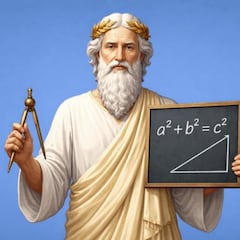
A philosopher from the fifth century BCE, Empedocles saw the world as a constant interplay of forces that unite and separate.

Empedocles, philosopher: When everything falls apart, it’s not always the end, sometimes it’s rearrangement
There are moments when life seems to fall apart without warning: a job that ends, a relationship that runs out of road, a stage of life that suddenly stops making sense. The instinctive reaction is usually the same - to interpret the break as failure or as a point of no return.
A notion attributed to Empedocles, the Greek philosopher of the fifth century BCE, challenges that reading. When everything collapses, it isn’t always an ending; sometimes it’s a reordering. The idea isn’t meant to soothe but to offer a different way of understanding collapse - not as defeat, but as a sign that a certain way of organizing life had already reached its limit.
Collapse doesn’t always destroy us - sometimes it reveals
When something breaks down, what falls apart is not only the visible result - a routine, a project, a dynamic - but the structure that held it together. The rupture exposes underlying tensions, imbalances that had been piling up, limits that could no longer stretch any further.
Empedocles saw the world as a constant interplay of forces that unite and separate. Applied to human experience, this suggests that many crises don’t appear out of nowhere: they are the point at which an exhausted structure stops functioning. Collapse doesn’t create the problem; it makes it unmistakably visible.
Interpreting a rupture this way doesn’t soften the emotional impact, but it does change the lens. Instead of asking only, “What did I lose?”, another question emerges: “What was already no longer holding up?” That shift marks the beginning of a deeper understanding of the moment you’re living through.
The pause needed to see what truly fell apart
One of the most common mistakes after a rupture is to try to rebuild immediately - to return to what was, to fill the void, to restore the familiar shape. But the idea of reordering requires a deliberate pause: a moment to observe which pieces came loose and why.
Not everything that breaks deserves to be repaired. Sometimes what falls apart is an imposed identity, an inherited expectation, or a way of living that no longer fits the present reality. Stopping to look allows you to distinguish what hurts because it mattered from what hurts simply because it was familiar.
This pause is a space for reading and understanding. Looking at the break without urgency helps avoid automatic reconstructions that repeat the same pattern under a different name. In practical terms, it’s the moment to redefine priorities, revisit decisions, and accept that not everything lost needs to be recovered.
To reorganize is to choose a different response
The heart of the idea attributed to Empedocles lies in what happens after the collapse. Reorganizing isn’t about denying what happened or covering it with forced optimism - it’s about deciding which elements to carry forward and under what logic. It is a conscious response, not an automatic reaction to pain.
Accepting this means acknowledging the hurt without letting it be the only guiding principle. It also means letting go of the fantasy of returning to the previous state. If a new structure is possible, it will be different - with new rhythms, new rules, and often clearer boundaries than before.
Here it’s important to draw a line: not every rupture is good, and not every crisis is an opportunity. Some losses are real, some grief cannot be balanced out, and some harm leaves lasting marks. The idea doesn’t romanticize the break; it simply avoids the mistake of forcing the reconstruction of something that had already shown it couldn’t hold.
In the end, interpreting collapses as potential reconfigurations doesn’t change what happened, but it does change what comes next. When something breaks, it’s not always about saving what once was - it’s about deciding, with greater clarity, what is worth leaving behind.
Related stories
Get closer to the game! Whether you like your soccer of the European variety or that on this side of the pond, our AS USA app has it all. Dive into live coverage, expert insights, breaking news, exclusive videos, and more. Plus, stay updated on NFL, NBA and all other big sports stories as well as the latest in current affairs and entertainment. Download now for all-access coverage, right at your fingertips – anytime, anywhere.
And there’s more: check out our TikTok and Instagram reels for bite-sized visual takes on all the biggest soccer news and insights.
Complete your personal details to comment