


How surgeons restored his sight in a remarkable way: by implanting his own tooth into his eye
A man in Canada is looking forward to a “new chapter” after regaining his sight thanks to a remarkable, last-resort procedure.
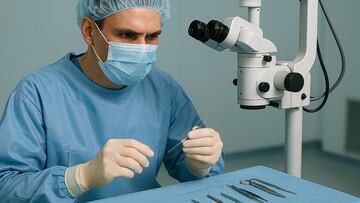

A Vancouver man says he is in a “whole new world” after undergoing a rare procedure that restored his sight - by inserting a tooth into his eye.
Brent Chapman, 34, lost his vision in his early teens when an extreme allergic reaction to medication left him permanently blind in his left eye, and caused severe damage to the cornea in the other.
But Chapman now enjoys near-standard vision out of his right eye after doctors used one of his teeth to fashion a replacement cornea, in a multi-stage operation carried out over the course of several months.
According to ABC Eyewitness News, Chapman is the first person in Canada to undergo the surgery.
What is the cornea and what is it for?
The clear, outermost layer of the eyeball, the cornea is essential to proper vision. Per SUNY Downstate Health Sciences University, the cornea is “as smooth and clear as glass but is strong and durable”, and serves two functions.
Firstly, it helps to protect the eye from “germs, dust, and other harmful matter”, SUNY Downstate notes.
Secondly, the cornea serves as a lens that “controls and focuses the entry of light into the eye”. It “contributes between 65-75 percent of the eye’s total focusing power”, SUNY Downstate explains.
What vision-saving surgery did Chapman undergo?
A complex procedure that very few surgeons are qualified to carry out, the operation is known as osteo-odonto-keratoprosthesis (OOKP), but is colloquially referred to as “tooth-in-eye” surgery. It was first developed in the 1960s, by the Italian eye surgeon Benedetto Strampelli.
According to the eye-surgery experts Optimax, the procedure is very much a last resort - an alternative to turn to when treatments such as cornea transplants do not work or aren’t possible. “It is not a first-line treatment and is typically considered when all other options have been exhausted,” Optimax says.
“I think I’ve had 10 cornea transplants now in 20 years‚” Chapman told CTV News in February, as he prepared to begin his tooth-in-eye surgery.
Over the past two decades, Chapman’s series of transplants had proved unsuccessful: they provided only short-term, limited restoration of his right eye’s vision. “We would put a new cornea in. It would last sometimes just a few months or even up to years, but it would just kind of never heal,” he explained to CNN.
Chapman told NBC’s Today show: “It was very devastating when I would lose that vision again, so we couldn’t keep going down that road.”
What is tooth-in-eye surgery?
As explained by Optimax, tooth-in-eye surgery involves removing one of the patient’s canine or premolar teeth and shaving it into a “bolt”-like shape.
A clear, plastic tube is inserted through the middle of the tooth, to act as a lens. The tooth-with-plastic-lens is then placed in the patient’s eye, underneath lining taken from the person’s cheek.
The advantage of using a tooth is that it is highly durable and is unlikely to be rejected by the patient’s body.
“Incredibly rewarding”
Dr. Greg Moloney, who led the team that carried out Chapman’s procedure, told CTV: “In essence, we are trying to really just replace a clear window on the front of the eye, and the tooth is the perfect structure to hold a focusing piece of plastic, or a telescope, for the patient to see through.”
The surgery allows patients to “recover close to normal vision”, Dr. Moloney added.
As explained by the American Optometric Association, standard visual acuity is known as 20/20 vision, meaning that you “can see clearly at 20 feet what should normally be seen at that distance”. Chapman, who wears dark glasses that reduce glare, now has about 20/30 vision in his right eye, Dr. Moloney told CNN.
With 20/30 vision, you need to be 20 feet away from an object to perceive it as clearly as a person with standard vision would see it from 30 feet. Per the Canadian eye-sight specialists Vivid Eyecare, someone with 20/30 sight experiences “slightly reduced sharpness“.
“We both burst into tears”
Talking to CBC News after his successful tooth-in-eye surgery, Chapman said: “I feel fantastic - vision comes back and it’s a whole new world. When Dr. Moloney and I made eye contact [for the first time], we both just burst into tears. I hadn’t really made eye contact in 20 years.”
Chapman also told CTV: “I’m really excited to open another chapter in my life […]. It’s just going to open up so many more doors for me.”
“To watch [patients] come back into the world is an incredibly rewarding feeling,” Dr. Moloney said to CBC.
Related stories
Get your game on! Whether you’re into NFL touchdowns, NBA buzzer-beaters, world-class soccer goals, or MLB home runs, our app has it all.
Dive into live coverage, expert insights, breaking news, exclusive videos, and more – plus, stay updated on the latest in current affairs and entertainment. Download now for all-access coverage, right at your fingertips – anytime, anywhere.
Complete your personal details to comment