


How the “water eyes” work in the middle of the Sahara Desert
The Great Man-Made River Project was an engineering project financed by Gaddafi, designed to supply coastal Libya with fossil water from the Sahara dating back to the last ice age.
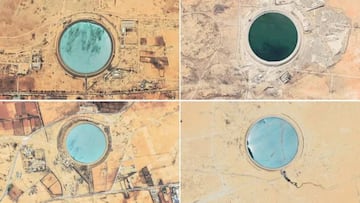

Libya’s Great Man-Made River Project was conceived in the late 1960s after the discovery of large fossil aquifers in the southern part of the country during oil exploration in 1953. These deposits belong to the Nubian Sandstone Aquifer System, which stores thousands of cubic kilometers of freshwater accumulated after the last glaciation.
Subsequent analysis showed that this discovery was part of the Nubian Sandstone Aquifer System, a vast reservoir of “fossil water” between 10,000 and 1,000,000 years old. This water seeped into the sandstone before the end of the last ice age, when the Sahara region enjoyed a temperate climate. Initially, the Libyan government planned to establish large-scale agricultural projects in the desert where the water was found. However, in the early 1980s these plans were changed, and designs were prepared for a massive pipeline network leading to the coast.
In the early 1970s, Muammar Gaddafi’s regime decided to finance an ambitious engineering project without foreign assistance. The Great Man-Made River Project Authority was officially established with approval from the General People’s Congress on October 3, 1983.
Timeline
- 1984: Gaddafi laid the first stone in Sarir, marking the start of construction.
- 1986: The prefabricated pipe plants in Brega and Sarir opened. In collaboration with the Italian company Redaelli Tecna for prestressing wires, these facilities were considered the largest in the world for prestressed concrete.
- March 1990: An agreement was signed between UNESCO and the Great Man-Made River Project Authority of the Libyan Jamahiriya within a framework of institutional communication and cooperation. It was registered under code FR PUNES AG 08 LEG A 946 in UNESCO’s archives. Annual awards were planned to promote research using new technologies, although only awards from 2001 and 2007 are officially recorded.
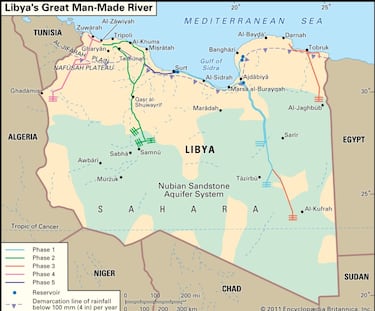
- Construction was organized into five main phases. The first phase was completed on August 28, 1991, after excavating 85 million cubic meters of earth, and the initial network entered service.
- The second phase became operational on September 1, 1996, delivering water to Tripoli for the first time.
The hidden rivers under the Sahara Desert
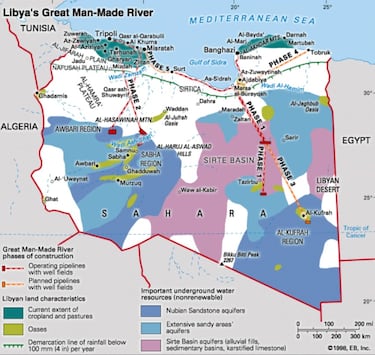
The network consists of more than 1,300 wells, each over 1,640 feet deep, with pipelines totaling approximately 1,750 miles in operation and up to 2,485 miles across various stages. The current estimated daily capacity is just over 1,7 billion gallons of freshwater, supplying nearly 70 percent of Libya’s urban consumption, including Tripoli, Benghazi, and Sirte. If groundwater reserves were depleted, the region would face severe water shortages unless adequate desalination infrastructure are established.
The Nubian Aquifer, which spans parts of Chad, Egypt, Libya, and Sudan, is the largest fossil water system in the world. It covers about 772,204 square miles and is estimated to contain roughly 39,6 sextillion gallons of water. To grasp its size, the system is almost as large as mainland Argentina, essentially an Argentina filled with water.
Fifth phase nearing completion, but system won’t fully meet Libya’s demand
At present, the fifth phase is close to completion and is estimated to cost $7 billion. This phase will expand coverage to rural and northern areas that are still unconnected. However, recent obstacles include the 2011 civil war, which led to reductions in public funding, power supply failures, infrastructure damage, and difficulties importing spare parts. It should be recalled that on July 22, 2011, NATO attacked Libya’s aqueduct system, specifically a water pipe factory in Al Brega that was part of the civilian water supply network serving 70 percent of the Libyan population.
In addition, there is a gap between production costs and consumer pricing, making financial sustainability difficult. The aquifer is nonrenewable, as it consists of fossil water. Some estimates warn of depletion within the twenty-first century unless desalination is adopted and efficient management is achieved.
While the project has improved quality of life and reduced pressure on coastal aquifers, its long-term viability remains uncertain. Strategic measures are recommended, including a sustainable financial plan, efficient pricing, continuous maintenance, smart water management, and water-saving technologies. Since this is a finite resource, desalination and water recycling must be integrated to extend its lifespan without compromising fossil aquifer extraction.
Layla Ali Al Toomi, author of a study published in Libyan Hydraulic and Water Resources Management, estimates that even after all phases are completed, the project would supply only 607.6 billion gallons per year compared with a projected demand of 2,6 trillion gallons per year by 2035. She therefore emphasizes the need to invest in desalination and water reuse.
The largest fossil water system in the world could be used to turn Libya green
“Libya could start an agro-business similar to California’s San Joaquin Valley,” said Patrick Henningsen, editor and founder of 21st Century Wire told the Inter Press Service. “Like Libya, California is essentially desert but because of irrigation and water works projects that desert valley became the largest producer of food and cotton in the world,” he explained.
“At the moment the only agro-markets in the Mediterranean zone competing to supply citrus and various other popular supermarket products to Europe are Israel and Egypt. In 10 or 20 years, Libya could surpass both of those countries because they now have the water to green the desert,” he added.
Related stories
Get your game on! Whether you’re into NFL touchdowns, NBA buzzer-beaters, world-class soccer goals, or MLB home runs, our app has it all.
Dive into live coverage, expert insights, breaking news, exclusive videos, and more – plus, stay updated on the latest in current affairs and entertainment. Download now for all-access coverage, right at your fingertips – anytime, anywhere.
Complete your personal details to comment