


Indiana University researchers discover strange animal behavior: How the 2024 solar eclipse confused birds
The “Great American Eclipse” in April 2024 gave researchers a once-in-a-lifetime opportunity to study the celestial phenomenon’s effects on birds.
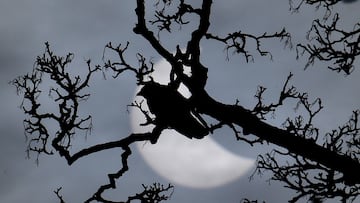

Total solar eclipses capture the imagination as they turn day into night for a brief moment when the Moon blocks out the light from the Sun. Most of us will be lucky if we only see one in our lifetimes as they only occur once every three to four hundred years in the same location.
It’s been observed that these celestial events have an effect on animal behavior, which like humans will likely never have experienced one before. The “Great American Eclipse” in April 2024 gave researchers a prime opportunity to study this in more detail.
Scientists at the Indiana University Bloomington in anticipation of the total solar eclipse set up a study to observe how wild birds would react to the rapid changes in light that could not be reproduced in a laboratory.
They enlisted the help of over 10,000 citizen scientists using a smartphone app called “SolarBird” they created along with autonomous recording units and an AI system called BirdNet to analyze the observations. The researchers recently published their findings from the data collected in the journal Science.
How the 2024 total solar eclipse confused birds
The timing of the April 2024 total solar eclipse was especially ideal for this natural experiment as it came at a time when birds are establishing territories and searching for mates. Typically, they become dramatically more vocal each day around dawn and dusk, especially near the spring equinox which occurred not long after the eclipse.
They were seeking to observe vocalizations before, during and after the celestial event to see how the birds would modify their behavior to the rapidly changing light. What they found was that over half of the 52 focal bird species displayed evident changes during at least one time period.
As the eclipse set in and skies darkened, 11 species became more vocal than normal for that time of day. During totality half became more active while the other half went quiet. The return of sunlight saw the biggest change; 19 species began singing what the scientists called a “pseudo-dawn chorus” to welcome a new day.
Two species that stood out were the barred owls and American robins, who produced four times and six times, respectively, more calls than they normally would at that time of day just after totality.
Chorus for solar eclipse displays birds’ sensitivity to light
These changes in vocalization were only observed in areas where sunlight was obscured by 99% or more. The research showed that some species are especially sensitive to changes in light which requires urgent understanding as the night skies become brighter with artificial lights.
Fortunately, the study also showed the ability of AI technologies to enlist the public more in large observations such as this one that spanned from Mexico to Canada. It promises to lower the bar for the public to actively engage in science.
This will help to deepen mankind’s understanding of the natural world as we move through the Anthropocene, defined by humanity’s ever greater impact on the Earth’s climate and ecosystems.
Related stories
Get your game on! Whether you’re into NFL touchdowns, NBA buzzer-beaters, world-class soccer goals, or MLB home runs, our app has it all.
Dive into live coverage, expert insights, breaking news, exclusive videos, and more – plus, stay updated on the latest in current affairs and entertainment. Download now for all-access coverage, right at your fingertips – anytime, anywhere.
Complete your personal details to comment