


Isaac Newton, scientist: “What we know is a drop of water, what we don’t know is an ocean”
His works Principia and Opticks revolutionized knowledge of the cosmos, light, and the behavior of matter.
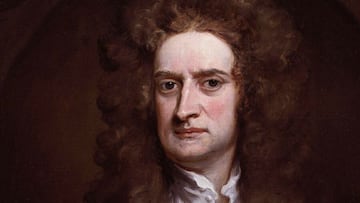
The celebrated scientist Isaac Newton was born on January 4, 1643, in Woolsthorpe, England. He was a physicist and mathematician who left a valuable and influential legacy by extending the earthly laws of mechanics to the entire cosmos, showing that nature is governed by universal laws.
Among his most important works is Principia (1687), in which he formulated the Law of Universal Gravitation and the laws of motion, and Opticks (1704), where he studied the nature of light, optics, and color theory.
His childhood was difficult. His father died before he was born, and his mother left him in the care of his grandmother in order to marry an Anglican clergyman. When his mother was widowed, she returned to him when he was eleven years old. Newton grew up as a shy and introverted child.
In 1665, Isaac Newton discovered the spectrum of light by passing a beam of sunlight through a glass prism in his room. He also experimented with his own eyes by inserting a bodkin (a blunt needle) between his eyeball and the bone as far as he could, and pressing his eye with the… pic.twitter.com/2MbEPpR3zo
— Physics In History (@PhysInHistory) January 11, 2026
A follower of Descartes
At the age of nineteen, he entered the University of Cambridge, where he received extensive training in mathematics. Although he was influenced by Descartes, he developed his own critical way of thinking.
Among his most famous quotes are, “What we know is a drop, what we don’t know is an ocean,” and, “A man may imagine things that are false, but he can only understand things that are true, for if the things be false, the apprehension of them is not understanding.”
As an interesting fact, he was the first scientist in the history of Great Britain to be knighted by the queen. Although he is often associated with the image of an apple falling on his head, he himself explained that he observed the fruit falling from a window.
Newton died on March 20, 1727, according to the Julian calendar, and on March 31 according to the Gregorian calendar. He was buried in Westminster Abbey, where much of Britain’s intellectual community gathered to honor him.
Related stories
Get your game on! Whether you’re into NFL touchdowns, NBA buzzer-beaters, world-class soccer goals, or MLB home runs, our app has it all.
Dive into live coverage, expert insights, breaking news, exclusive videos, and more – plus, stay updated on the latest in current affairs and entertainment. Download now for all-access coverage, right at your fingertips – anytime, anywhere.
Complete your personal details to comment