


Josef Aschbacher, ESA Director, on comet 3I/ATLAS: “We know very well what is happening”
The director responds to the “speculation” about the presence of aliens on the comet and sets a date for the day of closest approach to Earth.
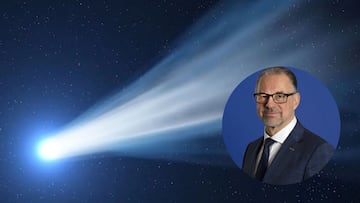

The interstellar comet 3I/ATLAS is the third celestial object ever recorded as coming from another solar system. Since its discovery on July 1 of this year by the ATLAS network (Asteroid Terrestrial-impact Last Alert System) in Chile, its journey through the planetary system has prompted months of research, tracking, and debate.
Amid questions surrounding the comet’s origin, the director of the European Space Agency (ESA), Josef Aschbacher, has dismissed any speculation about its nature or composition. According to Aschbacher, experts have closely studied the object as it passes through the solar system and have confirmed that it is not of alien origin. While some theories claim the comet could be extraterrestrial beings traveling through our solar system, the reality is very different.
“It is a comet moving at very high speed as it passes through our solar system. We have measured it, we are observing it, and we know very well what is going on,” Aschbacher explained in an interview with Europa Press. As further evidence that the comet is not an alien object from another part of the universe, ESA’s Jupiter Icy Moons Explorer (JUICE) mission captured an image of the body that clearly shows the materials it is made of.
🪐 The interstellar object 3I/ATLAS WILL NOT collide with Earth.
— Tansu Yegen (@TansuYegen) October 26, 2025
On December 19, it will only reach its closest approach, at about 268 million km…#3IATLAS
pic.twitter.com/3ROENo3NYA
Approaching this week
After its close approach to the Sun on October 29 and to Mars on October 3, the comet is now heading toward Earth. ESA has announced that 3I/ATLAS will make its closest approach at a distance of about approximately 153.5 million miles (274 million km) from Earth this Friday, December 19.
During its trajectory, the comet passed within approximately 18 million miles (29 million km) of Mars, allowing ESA scientists to refine predictions about its path through the solar system. Researchers also estimate that the comet has a nucleus between 10 and 30 kilometers in diameter and follows a hyperbolic orbit, confirming that it does not belong to the solar system. It is traveling at a speed greater than 42 miles per second (68 km/sec), equivalent to roughly 152,000 mph (245,000 kmph).
Related stories
Get your game on! Whether you’re into NFL touchdowns, NBA buzzer-beaters, world-class soccer goals, or MLB home runs, our app has it all.
Dive into live coverage, expert insights, breaking news, exclusive videos, and more – plus, stay updated on the latest in current affairs and entertainment. Download now for all-access coverage, right at your fingertips – anytime, anywhere.
Complete your personal details to comment