


Key discovery by the Curiosity rover on Mars
Scientists have discovered traces of organic molecules on the Red Planet and are not ruling out the possibility that they were produced by living organisms.
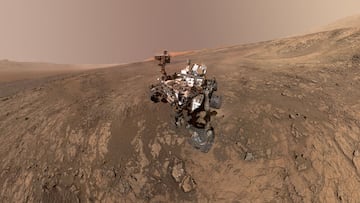
The discovery of life on the Red Planet may be closer than ever. The Curiosity rover, one of the two robots operated by NASA to explore the surface of Mars, found rock remnants in March 2025 containing organic compounds, a fundamental component of living organisms on Earth. The rover’s instruments immediately analyzed the rock sample, and scientists reported identifying traces of three different organic materials: decane, undecane, and dodecane.
The discovery of life on Mars is not yet official. However, according to a study published on February 4 in the scientific journal Astrobiology, the organic remains in the rock sample may not be the only relevant factor.
The Curiosity rover landed on Mars in August 2012 and, along with the Perseverance rover, continues to traverse the planet’s surface in search of evidence of life that may have existed long before humanity. This new sample opens the possibility that life may once have existed on the Red Planet.
The rover’s location is not accidental. Scientists believe that the geology of Mars may contain valuable clues about past life. The robot first landed in Gale Crater, at the boundary between the heavily cratered southern highlands and the smoother northern plains.
One year ago (Feb 7, 2025), NASA’s Curiosity rover stood on Mount Sharp and captured a panoramic view looking down into Gale Crater.
— Kekius Maximus (@Kekius_Sage) February 17, 2026
Yes, this is Mars, about 140 million miles away. pic.twitter.com/9TCHxhkDk9
Since then, Curiosity has collected a total of 42 powdered rock samples using the drill mounted at the end of its robotic arm. Among these samples, the one collected in 2025 contains the largest organic compounds ever found on Mars. These are fragments of fatty acids preserved in shale from Gale Crater, which on Earth typically originate from living organisms.
Life 80 million years ago
NASA noted in a blog post about Curiosity’s observations that the findings are not sufficient to confirm the existence of life on Mars. Scientists understand that the rover’s measurements alone cannot determine whether the molecules in the samples were produced by living organisms. For this reason, researchers conducted additional analysis based on the new discovery.
One possible explanation for the presence of fatty acids on the Martian surface is the impact of a meteorite. To address this question, scientists used radiation simulations and mathematical models to look back approximately 80 million years, the period during which the organic compounds are believed to have been exposed on Mars. Any organic material would have had to exist before being gradually destroyed by cosmic radiation.
Curiosity has been working the night shift on Mars!
— NASA Mars (@NASAMars) January 28, 2026
Using the LED lights on the end of its robotic arm, it created this rare nighttime view. It shows a small hole that the robotic geologist bored into the bedrock, revealing layers inside. Drill into the details:… pic.twitter.com/QQWtOcRDDO
According to NASA’s publication, the researchers’ analysis of the rover’s rock samples concluded that non-biological sources could not fully explain the abundance of organic compounds on Mars. Even so, the findings only suggest that life on the Red Planet remains a possibility.
The samples are not sufficient proof that life once existed on Mars. Confirming such a conclusion will require further studies to explain the processes by which the organic molecules formed and later decomposed.
Related stories
Get your game on! Whether you’re into NFL touchdowns, NBA buzzer-beaters, world-class soccer goals, or MLB home runs, our app has it all.
Dive into live coverage, expert insights, breaking news, exclusive videos, and more – plus, stay updated on the latest in current affairs and entertainment. Download now for all-access coverage, right at your fingertips – anytime, anywhere.
Complete your personal details to comment