


Martin Cordiner, NASA astrochemist, reveals what gases are on the 3I/ATLAS: “In this alien comet they’re very abundant”
Scientists have been fascinated by the third interstellar object to ever known to visit our solar system that is revealing more and more surprising secrets.

3I/ATLAS was discovered this summer on 1 July and it has captured the imagination of scientists and the public. The alien comet is the third object ever known to have visited our solar system that originated from somewhere else in the Milky Way.
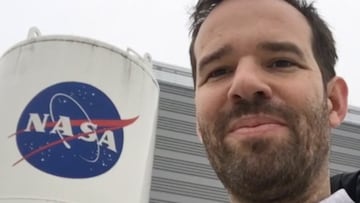
As it speeds through our solar system, astronomers have been tracking its whereabouts and trying to glean as much information about the object as they can. Astrochemist Martin Cordiner and his colleagues at NASA’s Goddard Space Flight Center, using the Atacama Large Millimeter/submillimeter Array (ALMA) in Chile, have detected something truly surprising; 3I/ATLAS is abundant in carbon-rich chemical compounds that are a key ingredient to the formation of life on our planet.
“In this alien comet they’re very abundant”
In particular the Goddard researchers were taken aback by the sheer amount of two molecule compounds that 3I/ATLAS was belching out, methanol and hydrogen cyanide. “Molecules like hydrogen cyanide and methanol are at trace abundances and not the dominant constituents of our own comets,” explained Cordiner to NewScientist.
“Here we see that, actually, in this alien comet they’re very abundant,” the astrochemist added.
🆕 Hubble reobserved interstellar comet #3IATLAS on 30 November with its Wide Field Camera 3 instrument. At the time, the comet was about 286 million kilometres from Earth: https://t.co/XW6zLkOpG8
— HUBBLE (@HUBBLE_space) December 5, 2025
Hubble tracked the comet as it moved across the sky. As a result, background… pic.twitter.com/dRQAaV1t8p
Both compounds were found coming from relatively close to the rocky core of the comet, but methanol was also found in the alien visitor’s coma, the fuzzy, cloud-like atmosphere of gas and dust that surrounds a comet and forms into its tail. This suggests that the nucleus of the comet is not uniform, which Cordiner says could help inform about where 3I/ATLAS came from.
There is also a stark difference in the amount of each compound being produced by the comet. While 3I/ATLAS was shedding roughly a quarter to a half a kilogram per second of hydrogen cyanide, the researchers measured around 40 kilograms per second of methanol being produced.
The two compounds represent in the ballpark of 2% and 8%, respectively, of the total gas vapor coming from the comet.
☄️ Our #ESAJuice team couldn't wait until February, when they will receive data on #3IATLAS from the mission's science instruments.
— ESA Science (@esascience) December 4, 2025
So they downloaded just a quarter of an image from its navigation camera to get a surprise sneak preview.
More info and annotations 👉… pic.twitter.com/e8JGpOkCfd
Does 3I/ATLAS pose a threat to Earth?
3I/ATLAS made its closest approach to the Sun in late-October and is currently moving out of the inner solar system. It will be at its closest point to the Earth around 19 December, but poses no threat as it will be some 170 million miles away, about 1.8 astronomical units according to NASA. Each AU is the distance from the Earth to the Sun.
Related stories


Get your game on! Whether you’re into NFL touchdowns, NBA buzzer-beaters, world-class soccer goals, or MLB home runs, our app has it all.
Dive into live coverage, expert insights, breaking news, exclusive videos, and more – plus, stay updated on the latest in current affairs and entertainment. Download now for all-access coverage, right at your fingertips – anytime, anywhere.
Complete your personal details to comment