


Meet the “invisible moon” that has been lurking around Earth for 60 years unseen by telescopes
Astronomers have found yet another quasi-moon companion of Earth in its orbit around the Sun believed to be a chunk of our primary Moon.

Given the vast darkness of space, it is always giving us surprises here on Earth. In July astronomers spotted the third interstellar object ever detected barreling toward the heart of our solar system, Comet 3I/ATLAS.
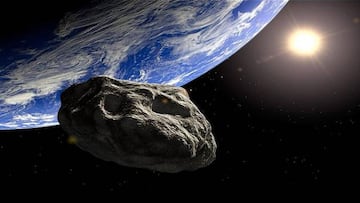
Now in a study published this month heavenly researchers say they’ve found another quasi-moon near Earth, joining the more than 100 others that are in Earth-like orbits. Dubbed 2025 PN7, it has been near us in our orbit around the Sun for the past six decades completely unnoticed until now.
Part of the reason it wasn’t seen before is that it is believed to measure perhaps 98 feet. This small size makes it incredibly difficult to see in the darkness of space and is only visible when it gets close to our planet.
2025 PN7 is part of a group of objects in the so-called Arjuna secondary asteroid belt. When the first of these asteroids was discovered in 1991, a speculative hypothesis was that it could be an interstellar probe.
However, over thirty years on, they are now widely accepted to be natural space rocks that occupy the same orbit as the Earth and Moon explained astronomers Carlos de la Fuente Marcos and Raúl de la Fuente Marcos in a paper published in the journal Research Notes of the American Astronomical Society this month.
At least some of these quasi-moons, including 2025 PN7, Kamo‘oalewa and 2024 PT5, are believed to be ancient chucks of our primary moon that got blasted off. This latter quasi-moon, 2024 PT5, became a mini-moon for a short time between late September and late November last year.
Quasi-moon versus mini-moon
The difference between quasi-moons and mini-moons is their orbits. The former are “engaged in a 1:1 mean-motion resonance with our planet, but they are not gravitationally bound to it,” explain the astronomers in their paper.
However, every now and then one of them gets captured by Earth’s gravity and they become mini-moons. This status is temporary and generally lasts just a matter of months.
A simulation of Earth's present and former quasi satellites as described in the Carlos de la Fuente Marcos and Raúl de la Fuente Marcos paper https://t.co/WfMKgYXmyX including newly-discovered 2025 PN7, first recognized as quasi by @AdrienCoffinet pic.twitter.com/mrSvjv2BFv
— Tony Dunn (@tony873004) September 14, 2025
As for 2025 PN7, the researchers expect that it will be in our vicinity as we travel around the Sun for another 60 years or so and doesn’t present a threat to the Earth. When it separates from Earth it will go into a horseshoe orbit around the Sun, as displayed in the video above.
Related stories
Get your game on! Whether you’re into NFL touchdowns, NBA buzzer-beaters, world-class soccer goals, or MLB home runs, our app has it all.
Dive into live coverage, expert insights, breaking news, exclusive videos, and more – plus, stay updated on the latest in current affairs and entertainment. Download now for all-access coverage, right at your fingertips – anytime, anywhere.
Complete your personal details to comment