


Miners discover an unusual 37.4-carat diamond: half pink, half colorless
Researchers are analyzing the new find at the mine in northern Botswana and paying attention to a quality never before documented.
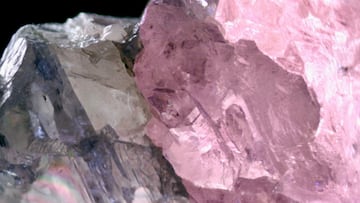

The Karawe mine is making headlines again after the discovery of a 37.41-carat rough diamond with an internal cleavage consisting of a pink half and a completely colorless half. This specimen joins the long list of large crystals found at the African site, such as the 2,488-carat Motswedi diamond discovered in 2024. Thanks to its geological setting, the Archean cratonic crust and deep kimberlite intrusions make the site a reliable source of Type IIa diamonds, with significantly low concentrations of nitrogen and other impurities.
The 37.41-carat crystal, with a flat boundary between the two zones intact and free of admixtures, attracted the attention of geoscientists and gemological laboratories worldwide for its unique qualities. This contrast in an uncut stone allows researchers to create a physical record of the conditions within the Earth’s mantle. The specimen is currently undergoing analysis at a facility in Gaborone, where experts are conducting non-invasive tests focused on mapping defect centers and internal stresses. So far, published images of the crystal show lattice structures consistent with two distinct growth phases.
The images are the result of initial assessments by researchers from the Gemological Institute of America (GIA), who confirmed that the diamond, like the rest of the crystals in the Karawe deposit, belongs to Type IIa. According to Earth.com, the pink part of the crystal shows plastic deformation it underwent in the past, a permanent distortion of the atomic lattice under intense geological pressure. This result is due to the chemical purity of Type IIa diamonds, which allows for the study of internal deformation and structural characteristics.
IShowspeed's visit to Botswana revealed how diamond trading is run
— kie 🇺🇸🇳🇬 (@mr_chiboi) January 31, 2026
AJ plus reported : IShowSpeed tried to buy diamonds in Botswana, and learned a lesson about the country’s lack of full control over its own resources. Botswana is the second-largest producer of diamonds in… pic.twitter.com/WbcpwOD8m5
A diamond that surpasses all others
The pink hue of half the crystal comes from plastic deformation, a process that occurs in diamonds and alters the interaction of light with the crystal structure. This results in a pink color without the presence of foreign atoms. When intense deformation occurs, the pink hue of the crystals tends toward browner tones. In this case, the Karawe crystal underwent deformation that gave it its characteristic intense pink hue, but without reaching brown. However, not all of the diamond exhibits this quality; the colorless half of the crystal must have grown under conditions of less mechanical stress and without lattice distortion.
It is not the first documented diamond to exhibit two different color qualities. However, compared to previous specimens, the new African crystal far exceeds two carats, a quality the others did not achieve, and displays partial transitions or irregular patterns. Thanks to its sharp boundary between the two halves, its large size, and its intact state, the crystal offers researchers an exceptional opportunity to make direct comparisons of stress-induced, distortion-free diamond growth on a single specimen.
Related stories
Get your game on! Whether you’re into NFL touchdowns, NBA buzzer-beaters, world-class soccer goals, or MLB home runs, our app has it all.
Dive into live coverage, expert insights, breaking news, exclusive videos, and more – plus, stay updated on the latest in current affairs and entertainment. Download now for all-access coverage, right at your fingertips – anytime, anywhere.
Complete your personal details to comment