


Mysterious inscription leads researchers to possible whereabouts of Count Dracula’s tomb
One of the most controversial theories in European historiography is reignited: where is Vlad III of Wallachia, better known as Count Dracula, buried?
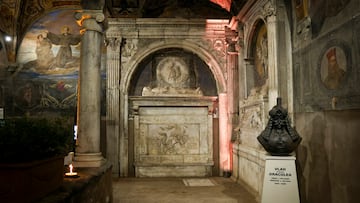
An enigmatic inscription, carved in stone more than five centuries ago, has reignited one of the most debated theories in European historiography: the possibility that Vlad III of Wallachia, better known as Count Dracula, is buried in the heart of Naples. The discovery, studied for over a decade, could forever change the narrative surrounding the prince’s final resting place.
The focus of the discovery is the Church of Santa Maria la Nova, a monumental complex in the historic center of Naples. There, in the chapel, lies a tomb that went largely unnoticed for centuries, but has drawn growing attention from Italian, Estonian, and Romanian researchers since 2014.
The reason? A series of symbols carved into the tombstone, including a dragon — the emblem of the Order of the Dragon, to which Vlad III belonged — and Egyptian signs that don’t match the traditional Neapolitan funeral iconography of the 16th century.
Professor Giuseppe Reale, director of the complex and an expert in medieval history, has been one of the most vocal figures in the investigation. In statements to Il Mattino, Reale confirmed that the inscription, previously undeciphered, has finally been translated by an interdisciplinary team.
“It’s a funerary tribute that explicitly mentions a prince from the East, a defender of the Christian faith, captured by the Turks and rescued by his daughter,” he explained. While the text doesn’t mention Vlad III by name, researchers believe that the references strongly align with his biography.
The theory that Dracula did not die in battle, as traditionally believed, but was instead captured by the Ottomans and later freed, gains new weight with this discovery.
According to this theory, his daughter Maria Balsa — said to have been adopted by a noble Neapolitan family after fleeing Turkish persecution — managed to bring her father to Italy, where he lived out his final days in anonymity. Upon his death, he would have been buried in the tomb of his father-in-law, Matteo Ferrillo, a local noble whose resting place is located in the Turbolo Chapel.
The theory’s origins date back to 2014
The roots of this theory go back to 2014, when a group of Italian academics, working with experts from Tallinn University, began analyzing the tomb’s iconography.
The presence of the dragon, symbol of the Order of the Dragon founded by Sigismund of Hungary in 1408 to defend Christianity from the Ottoman Empire, was the first clue. Then came the Egyptian symbols, which some interpret as a coded system meant to hide the true identity of the deceased.
The inscription, estimated to date to around 1520, was engraved in archaic Latin and contained encrypted elements that made it difficult to interpret for years.
Only recently, thanks to digital analysis techniques and the work of experts in historical cryptography, has its meaning been reconstructed.
“It’s not just an epitaph; it’s a coded message designed to protect the memory of a man who was both feared and hunted,” says Reale.
Related stories


Although the international academic community remains divided, the discovery has sparked renewed interest in the figure of Vlad III, whose legend was immortalized by Bram Stoker in his 1897 novel Dracula. For some, the discovery in Naples is nothing more than a symbolic coincide.
Get your game on! Whether you’re into NFL touchdowns, NBA buzzer-beaters, world-class soccer goals, or MLB home runs, our app has it all. Dive into live coverage, expert insights, breaking news, exclusive videos, and more – plus, stay updated on the latest in current affairs and entertainment.Download now for all-access coverage, right at your fingertips – anytime, anywhere.
Complete your personal details to comment