


Neither Greenland nor Ukraine: the historic European territory at risk from one of NATO’s allies
A long-running dispute between two NATO allies in the Aegean Sea is resurfacing, raising fears of a crisis the alliance may struggle to contain.
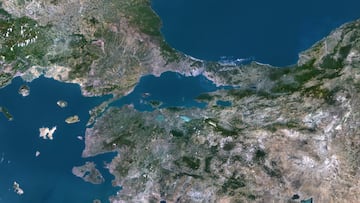
It is not Greenland. It is not Ukraine. The European territory most at risk right now lies in the Aegean Sea, at the center of a historic dispute between two NATO members, Greece and Turkey, that continues to keep foreign ministers and defense officials on edge.
While much of the international focus has turned to Greenland, following U.S. positioning, Denmark’s response and NATO’s potential reaction, another unresolved conflict closer to Europe’s core carries serious risks for the alliance itself.
Under Article 42.7 of the Treaty on European Union, EU member states are obligated to provide aid and assistance to any member that suffers an armed attack, using all available means. This mutual defense clause operates alongside NATO’s Article 5, which remains the foundation of collective defense for alliance members. The EU provision is designed to reinforce solidarity and coordination without creating an automatic European military command.
Why the Aegean remains volatile
In the Aegean, tensions revolve around territorial waters, airspace, exclusive economic zones, sovereignty over islands and islets, and access to natural resources. These disputes have already sparked serious military crises, most notably in 1987 and again in 1996, when Greece and Turkey came dangerously close to armed conflict.
Geography makes the situation especially combustible. The Aegean is dotted with Greek islands lying just miles from Turkey’s coastline. For Ankara, this proximity fuels territorial claims. For Athens, it feeds a deep sense of vulnerability and an existential security threat.
Greek fears and Turkish pressure
Greek officials worry that Turkey could escalate its claims or even attempt to exert control over Greek islands near the Turkish coast. President Recep Tayyip Erdogan has repeatedly hinted at such possibilities. Athens is also concerned about renewed challenges to Greek sovereignty over uninhabited islets, recalling the 1996 Imia, known in Turkey as Kardak, crisis.
Another flashpoint is the militarization of Greek islands. Turkey argues that Greece’s military presence violates international treaties, while Greece insists it is a purely defensive response to the threat posed by Turkish forces across the water.
Trump is discussing how to acquire Greenland, including attacking NATO-ally Denmark militarily. The only prior intra-NATO conflict was Greece and Turkey.
— Bryan Dawson🇺🇸 (@BryanDawsonUSA) January 8, 2026
It's not the first time the United States has eyed Greenland: https://t.co/GGwghgR65Y pic.twitter.com/27RKSujiE4
NATO’s uncomfortable dilemma
Complicating matters further, Greece and Turkey have both been NATO members since 1952. That reality places the alliance in an extraordinarily delicate position. In theory, an attack on one obligates all to respond. In practice, NATO officially avoids intervening in bilateral disputes between allies, limiting its role to facilitating dialogue and de-escalation.
The alliance traditionally refrains from taking sides on sovereignty issues. But if Turkey were to push beyond diplomatic pressure and take concrete action, NATO would face a moment it could not ignore. The situation echoes the broader questions raised by Greenland and how the alliance responds when tensions involve its own members.
Strategic leverage and leadership pressure
Greece increasingly feels that NATO does not protect it adequately from Turkish pressure, despite their shared alliance status. Turkey, meanwhile, leverages its strategic importance with little fear of internal consequences. Its position on NATO’s southern flank, its control over access to the Black Sea, and its influence in the Middle East all strengthen Ankara’s hand.
In this context, the role of NATO Secretary General Mark Rutte becomes pivotal. The stakes extend far beyond Greece and Turkey. How this dispute is managed will shape alliance credibility and could set precedents for other contested borders across Europe and beyond.
Related stories

Get your game on! Whether you’re into NFL touchdowns, NBA buzzer-beaters, world-class soccer goals, or MLB home runs, our app has it all.
Dive into live coverage, expert insights, breaking news, exclusive videos, and more – plus, stay updated on the latest in current affairs and entertainment. Download now for all-access coverage, right at your fingertips – anytime, anywhere.
Complete your personal details to comment