


On this day in 1971: NASA Astronaut Alan Shephard plays golf in space - How far did the moon shots actually travel?
Mission Control watched on with amusement as Apollo 14 Commander Alan Shepard teed off on the lunar surface.
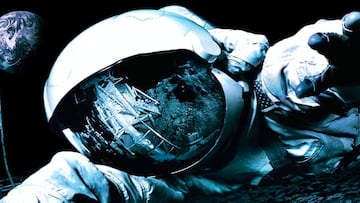
On February 6, 1971, 55 years ago today, one of the most memorable episodes in spaceflight history, and one of the most bizarre ‘sporting moments’ took place on the Moon’s dusty surface.
Alan Shepard, Edgar Mitchell and Stuart Roosa formed the three-man Apollo 14 crew, whose mission was to explore the Fra Mauro region, before returning to Earth with lunar samples, geological data and photographs.
Shortly after 4 p.m. on January 31, Apollo 14 launched from Kennedy Space Center, the start of a nine-day mission - a 1,150,321-mile round trip to the Moon and back.
On the morning of February 5, the lunar module touched down at the Fra Mauro formation. “And it’s been a long way, but we’re here,” Commander Alan Shepard was heard saying by the 52 million viewers eagerly watching the mission unfold on television back home. Five hours after landing, Shepard stepped out of the module and onto the Moon’s surface for the first extravehicular moonwalk (EVA).
“Not bad for an old man!”
— NASA History Office (@NASAhistory) February 5, 2026
Capcom Bruce McCandless ribbed Alan Shepard, one of America's first 7 astronauts, moments after he became the fifth—and oldest—person to walk on the lunar surface.
The Apollo 14 lunar module (Antares) touched down 55 years ago today, successfully… pic.twitter.com/lBjZ7N59v9
Apollo 14 mission: two moonwalks
The Modular Equipment Transporter (MET) was deployed and Shepard spent the next five hours conducting specific operations such as collecting and documenting lunar samples and photographing the terrain.
But it was right at the end of the mission’s second EVA that Shepard did something that took his own crewmates, and almost everyone back at Mission Control in Houston by surprise.
As he approached the module, Shepard pulled out a customized golf club - a Wilson Staff Dyna-Power 6-iron head attached to a collapsible tool used for scooping up lunar rock samples. Tossing a golf ball onto the Moon surface, he took a one-armed swing. His first attempt failed to connect, raking up “more dirt than ball” but with his second effort, he managed to make a clean strike, and ball appeared to fly a few meters, landing in a crater.
Back in Houston, the 30 controllers and engineers in Mission Operations Control Room 2 watched the images being beamed back to their monitors in disbelief.
Without hesitation, Shepard flung a second ball onto the surface and took aim. This time he made a clean contact and the ball whizzed into the distance. According to the astronaut, it went “miles and miles and miles...” But how far did the ball actually travel? That’s a question that will never be answered as Shepard had other responsibilities to attend to than playing a casual round of golf. His impromptu Moon shot was taken when his work was practically over and he never went to retrieve the ball.
Fore! When #Apollo14 astronaut Alan Shepard hit two golf balls on the Moon, he became the first lunar golfer in history. One of his golf balls landed in a crater about 50 ft (15 m) away, making this the first hole-in-one on another world. ⛳️ #MoonCrushMonday pic.twitter.com/aAuCa0L5Qi
— ARCHIVED - NASA Moon (@NASAMoon) February 1, 2021
Detective work to calculate distance traveled
The second ball was airborne for over 30 seconds and some observers estimate that it must have traveled around 40 yards. By studying the original flight film prints and television footage, comparing and contrasting with new mages taken from lunar orbit by the LRO in 2009, Andy Saunders managed to 1) locate where Shepard took his shot; 2) determine where the ball landed in the lunar soil and 3) calculate the distance between the two points.
Saunders worked out that the first ball traveled 24 yards and the second one, 40 yards. He notes that due to the “one-sixth gravity and lack of atmosphere, the ball traveled significantly farther than it would have on Earth”. It also stayed airborne longer due to lower gravitational forces pulling it back to the ground.
43 years ago today, Alan Shepard hit 3 golf balls on the moon. The "Moon Club" is on display at the USGA Museum: #tbt pic.twitter.com/rkjElEoD2T
— USGA (@USGA) February 6, 2014
Shepard kept his Moon shot a closely-guarded secret
It later transpired that the only other person who knew what Shepard had planned was mission director Bob Gilruth. Gilruth begrudgingly allowed the golf-loving astronaut to go ahead with his experiment as it would “showcase the gravitational differences between the Earth and the moon.”
In 1974, following his retirement from NASA, Shepard donated the customized club which he used for his famous Moon shot to the USGA Golf Museum in New Jersey where it remains on display.
Related stories
Get your game on! Whether you’re into NFL touchdowns, NBA buzzer-beaters, world-class soccer goals, or MLB home runs, our app has it all.
Dive into live coverage, expert insights, breaking news, exclusive videos, and more – plus, stay updated on the latest in current affairs and entertainment. Download now for all-access coverage, right at your fingertips – anytime, anywhere.
Complete your personal details to comment