


Rafa Abella, the seismologist who lives at the foot of a volcano in Antarctica: “I would love to experience an eruption on Deception Island”
The seismologist speaks with Diario AS from Antarctica, where he reflects on three decades of scientific research on Livingston Island.
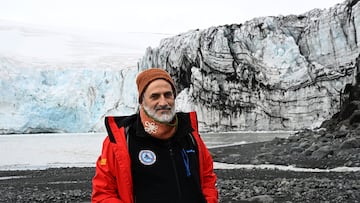
Juan Carlos I Base, Livingston Island (Antarctica). The wind takes your breath away, the ice crunches beneath your boots, and just a couple miles away, the ground trembles with the pulse of an active volcano.
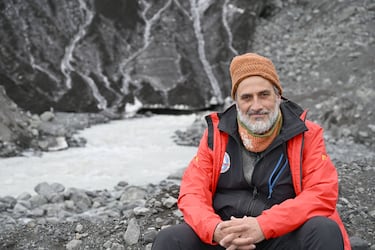
This is daily life for Rafa Abella (Madrid, 1968), a seismologist with Spain’s National Geographic Institute (IGN) and one of the leading figures in Spanish volcanic monitoring in Antarctica. Over the past 30 years, he has taken part in 14 Antarctic campaigns. “The first time I came was in 1995–96,” he recalls. “I never imagined I would come back so many times. It’s a privilege.”
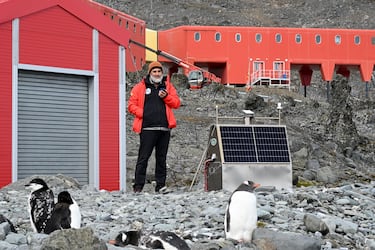
We spoke with him from Livingston Island, although much of his work takes place on Deception Island, one of the most singular active volcanoes on the planet. There, Abella and his team have built a new monitoring network that, in his words, “could be among the best-monitored volcanoes in the world.”
A natural laboratory: monitoring an Antarctic volcano
Deception Island is a living volcano whose most recent major eruptions occurred in 1967 and 1970, destroying Chilean and British bases. “Geologically speaking, fifty years is nothing. The volcano could reactivate at any time,” Abella explains. Their monitoring is based on three scientific pillars.
Seismology: listening to the Earth. “I always tell the younger researchers that we do what the Native Americans did in the movies,” he jokes. “They put their ear to the ground to see if the cowboys were coming. We place a microphone, a sensor called a geophone, and that’s how we detect any movement of magma.”
The seismic network, expanded campaign after campaign, can record extremely small earthquakes and now provides real-time data thanks to new Starlink-based communications that transmit information directly to IGN headquarters in Madrid. “That gives us tremendous peace of mind.”
Ground deformation. Using GNSS stations, essentially GPS, they observe whether the island is “breathing,” swelling, or deforming due to internal pressure. On some occasions, these anomalies have been the first warning signs before volcanic reactivation.
Geochemistry. They measure gases, temperatures, water acidity, and fluid composition. “If magma begins to rise, it would show up in these parameters,” he explains. This is the same methodology the IGN applies in the Canary Islands, the Campo de Calatrava volcanic field, and the Olot volcanoes.
An international-level scientific network
Spain is one of the few countries with a presence on Deception Island during the austral summer. There, the Gabriel de Castilla Base, operated by the Spanish Army, works side by side with the IGN scientific team. Collaboration is constant.
They also work with Argentina, which maintains its own small seismic network. “They have quite a few technical problems. We work together, but about 80 percent of the instrumentation is Spanish,” Abella notes.
Data flows to Madrid 24 hours a day, where an on-call team analyzes any change in activity. “If something happens, we are the ones who must notify the Polar Committee, which holds the political responsibility to act.”
Building an observatory in one of the most hostile places on Earth
Abella has witnessed the evolution of Spain’s scientific presence in Antarctica firsthand. He recalls his early years with a mix of surprise and nostalgia. “We arrived with 20 crates, spent three weeks setting everything up, and then dismantled it all again. We didn’t know if we would be able to return the following year.”
Everything changed after a visit by then-Minister Pedro Duque and officials from the Ministry of Science. “They realized Spain had a problem. How could the IGN not be here?”
Since then, continuity and resources have been guaranteed. Today, the team has stable infrastructure, robust communications, and cutting-edge equipment. “When people tell me that, I can hardly believe it. We were able to build a brand-new network from scratch.”
From El Hierro to La Palma: experiencing an eruption firsthand
Their experience in the Canary Islands guides their work in Antarctica. “With El Hierro, we saw how the magma moved, how the earthquakes began in the north and ended in the south. Three months in advance, we already knew something was going to happen,” he recalls.
Regarding the La Palma volcano, he adds, “It gave warnings for three years. It was a very well-monitored volcano.”
Would he like to experience an eruption on Deception Island? “Yes, of course. An eruption is an event. We are prepared. At six or seven kilometers away, it would be safe, unless there were magma-water interaction. But this is exactly why we are here.”
Science for the future and for society
Beyond daily monitoring, Abella emphasizes the importance of public outreach. From the base, they connect with Spanish schools almost every day. “It’s part of our mission. There is always a soldier or a scientist here explaining what we do.”
The data they collect, including glacier sounds, ice fractures, and even whale songs that their instruments pick up unintentionally, are analyzed and then made available through the National Polar Data Center so other researchers can carry out diverse studies.
Still, the IGN’s objective is clear. “We are a public service. We need real-time data to say whether an eruption could happen within three months. Research goes hand in hand with that, but our priority is protection.”
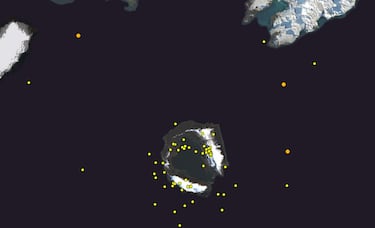
Enter if you dare ☠️
— NASA Earth (@NASAEarth) October 7, 2023
Deception Island, located off the Antarctic Peninsula, is one of the only places in the world where ships can sail directly into the center of an active volcano. #Landsat 8 captured this image in March of 2018. https://t.co/6RuDLUHC1s ⛴️🌋 pic.twitter.com/AQxE3zt2zi
Three decades later: what remains to be discovered?
Over 30 years in Antarctica, Abella has seen changes in the climate, sea ice, and technology, but some things remain constant: uncertainty, extreme beauty, and the feeling of standing at the edge of the world. “I always thought each trip would be my last. Now I want to come for as long as I can. It’s a unique experience. A privilege.”
Related stories

Get your game on! Whether you’re into NFL touchdowns, NBA buzzer-beaters, world-class soccer goals, or MLB home runs, our app has it all.
Dive into live coverage, expert insights, breaking news, exclusive videos, and more – plus, stay updated on the latest in current affairs and entertainment. Download now for all-access coverage, right at your fingertips – anytime, anywhere.
Complete your personal details to comment