


Record-sized fish caught in sub-freezing temperatures: “It’s really quite a difficult fish to fish. You’ve got to be really patient”
Late last month, an ice-fisher in Canada caught a huge halibut in Québéc’s Saguenay Fjord, having fought to reel the fish in for over two hours.
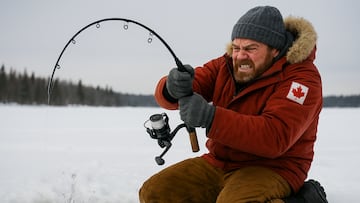

An ice-fisher in Canada has registered a record-breaking catch, reeling in an enormous Atlantic halibut weighing nearly 250 pounds.
Alain Hamel, an angler with the Comité de bassin de la Baie des Ha! Ha! (CBBH), a marine-life research group in Québec, caught the halibut in the Saguenay Fjord, a 60-mile stretch of water in the eastern Canadian province.
The catch came as part of a scientific ice-fishing project being carried out by CBBH in the fjord, in collaboration with Fisheries and Ocean Canada (DFO) and Saguenay’s Musée du Fjord.
“An incredible record”
In a social-media post, the Musée du Fjord revealed that on Saturday, Jan. 31, Hamel pulled in a 244-pound halibut measuring 2.05 meters (about 6 feet 8 inches) in length. “It’s the largest halibut caught since the scientific fishing [project] began - an incredible record,” the museum said on its Facebook page.
“Bigger than the fisherman”
Speaking to the Canadian Broadcasting Corporation (CBC), CBBH president Marc-André Galbrand said the Saguenay Fjord ice-fishing project has now set two new weight records this winter, surpassing the mark set by a 195-pound halibut last year.
Hamel’s historic halibut, Galbrand revealed, followed an earlier catch involving a 205-pound specimen. “It’s really a great season for us up to now,” he said, adding of the new record-breaker: “It’s really impressive. It’s bigger than the fisherman; it almost looks two times bigger.”
“Quite a difficult fish to fish”
According to the Musée du Fjord, Hamel had the huge halibut on the end of his fishing line for two and a half hours before finally managing to pull it up to the surface.
That’s actually “quite a reasonable time period” to tussle with a halibut, Galbrand said, revealing that another ice-fisher on the project recently engaged in a six-and-a-half-hour battle. “We had somebody who caught on a halibut [who] started at 10 o’clock in the morning and at 4:30 [in the afternoon] was still on the halibut,” he told CBC.
Halibut is “really quite a difficult fish to fish”, Galbrand added. “You have to have a good technique, you’ve got to be really patient and you have to go on to the physio after, because your arms are just killing you after that […].
“It’s an extreme fishing sport where you have to know what you’re doing. You’ve got to be careful, too, because the halibut have quite impressive teeth that are really sharp at times.”
Ice-fishing project collecting data on Saguenay halibut
It is normally illegal to fish for halibut in the Saguenay Fjord, but DFO has granted CBBH permission to catch a limited sample of the species during Québec’s ice-fishing season.
According to the province’s government, this period typically runs from January to mid-March, when the ice on bodies of water is thick enough to support ice-fishers and associated equipment and infrastructure, such as snowmobiles and huts. “Temporary fishing villages then start popping up on lakes and rivers,” explains Québec’s tourism ministry.
Launched in winter 2022, CBBH’s halibut project “aims to acquire additional scientific knowledge on this species and its presence in the Saguenay Fjord”, DFO says. The federal agency says it has issued a licence allowing CBBH to catch up to 35 halibut per season, limited to specimens over 8.5 meters (2 feet 9 inches) long.
“Studies suggest that the populations of some groundfish species in the Saguenay Fjord are ‘sink populations’, which means that they are isolated from those of the Estuary and Gulf of St. Lawrence.
“In the case of Atlantic halibut, this issue has been little studied and DFO lacks data to test this hypothesis. Therefore, the data collected during the project will help advance knowledge on the species.”
The Saguenay Fjord flows into the St. Lawrence Estuary, which in turn leads into the Gulf of St. Lawrence, located on Canada’s east coast.
Once caught, Galbrand told CBC, the Saguenay halibut are tagged and taken to the Musée du Fjord, where researchers weigh the fish and analyze aspects such as its bones, its sex and its apparent diet.
Jan. 31’s 244-pounder was the 27th halibut reeled in by CBBH ice-fishers this season, the Musée du Fjord revealed in its Facebook post. With few further catches allowed, Galbrand told CBC last week, program chiefs opted to temporarily suspend its activities “to make sure to not overshoot what was allowed in our scientific project”.
Related stories

Get your game on! Whether you’re into NFL touchdowns, NBA buzzer-beaters, world-class soccer goals, or MLB home runs, our app has it all.
Dive into live coverage, expert insights, breaking news, exclusive videos, and more – plus, stay updated on the latest in current affairs and entertainment. Download now for all-access coverage, right at your fingertips – anytime, anywhere.
Complete your personal details to comment