


René Descartes, French philosopher: “Truth is not found in the multitude of opinions, but in evidence”
In the age of noise and opinion, Descartes’ insistence on evidence over consensus feels unexpectedly modern – and deeply unsettling.
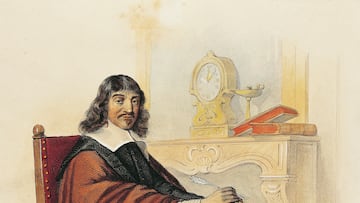

In the early modern period, with the 17th century just under way, medieval religiosity began to lose ground to rationality and science. Figures such as Galileo and Kepler raised the banner of the Scientific Revolution in a Europe increasingly preoccupied with culture, mathematics, astronomy and science more broadly.
The philosopher who saw social media coming
It was in this climate that René Descartes emerged. The French philosopher, regarded as the father of modern rationalism, laid the foundations of the scientific method and critical thinking. Over the course of his 54 years, he left teachings distilled in his most famous phrase: “I think, therefore I am.” He believed that truth could only be reached through doubt – by questioning absolutely everything that is not self-evident. From there, it is reason, not tradition, authority or opinion, that must determine whether something is true or false.
Along those lines, Descartes offered another celebrated dictum: “Truth is not to be found in the crowd of opinions, but in the evidence.” This lesson, echoed in works such as Discourse on the Method and Meditations on First Philosophy, argues that the only things that are evident are those that appear with such clarity that doubt becomes impossible.
Explaining fake news
That idea clashes with one of the key principles underpinning the democratic societies shaped in the 20th century: freedom of expression. Anyone may advance any idea without censorship, even if it is mistaken or unfounded, provided it does not infringe on the rights of others. Descartes, however, maintained that no matter how many voices repeat a claim, that does not make it true, implying that not all ideas carry the same epistemological weight.
Today, there are countless situations in which Descartes’ thinking comes into play. The most obvious is precisely this one. On social media, millions of people may opine on health, politics or science, but for Descartes the only reality that matters is scientific evidence. The same logic applies to climate change, vaccine denial and the spread of fake news.
There are even applications in sport. How often do we hear that certain coaches cling to traditional methods “because that’s how it’s always been done,” particularly when it comes to Big Data and advanced statistics? For Descartes, those who focus on data are closer to the truth than those guided by popular opinion – a panenkita well ahead of his time.
Related stories
Get your game on! Whether you’re into NFL touchdowns, NBA buzzer-beaters, world-class soccer goals, or MLB home runs, our app has it all.
Dive into live coverage, expert insights, breaking news, exclusive videos, and more – plus, stay updated on the latest in current affairs and entertainment. Download now for all-access coverage, right at your fingertips – anytime, anywhere.
Complete your personal details to comment