


Russia is investigating whether a 2.8-ton meteorite was smuggled into the United Kingdom as a garden ornament
The 'discreet' fragment of Aletai, weighing more than 2 tons, comes from one of the largest iron meteorites known on Earth.
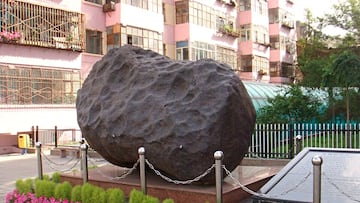
Russian customs officers have done it again. Investigators stopped a massive meteorite fragment from being smuggled into the United Kingdom after it was disguised—rather poorly—as a garden decoration, according to the Federal Customs Service.
This wasn’t exactly a subtle lawn ornament. The “decorative piece” weighed 2.8 tons... making it one of the least discreet smuggling attempts imaginable. Investigators say the fragment comes from the Aletai meteorite, one of the largest known iron meteorites on Earth. Authorities haven’t revealed the buyer or the price paid, but the unusual cargo was intercepted at the port of St. Petersburg.
“When they tried to export it, it was declared as a landscape sculpture,” officials said. “But an examination confirmed it was a fragment of the Aletai iron meteorite, valued at roughly €3.6 million.” Security forces have opened a criminal case for “smuggling strategically important goods or cultural property,” a charge that carries a maximum penalty of three years in prison.
It survived the journey from space… but it didn’t get through customs.
— CGTN Europe (@CGTNEurope) February 6, 2026
Customs officers in Russia’s St Petersburg prevented a 2.5-ton meteorite fragment from being exported from Russia to the UK. It was discovered during the scanning of a sea container.
Although the fragment… pic.twitter.com/goAfeMuCdp
A piece of a 4.5‑billion‑year‑old protoplanet
According to Russia’s TASS news agency, the fragment is believed to be part of the core of a protoplanet or large asteroid that broke apart around 4.5 billion years ago, during the formation of the solar system. The meteorite takes its name from the region where it struck—Xinjiang, in northwestern China. There are historical records of its presence, suggesting the impact happened in prehistoric times.
Discovered in 1898, Aletai is a well‑known siderite (an iron‑nickel meteorite) famous for its massive size and unusually high concentrations of gold and iridium. Investigators believe the fragment seized in Russia had previously been imported from a member state of the Commonwealth of Independent States, the alliance of former Soviet republics.
A meteorite with a long, heavy history
The Aletai meteorite—also known historically as Armanty in Russia or Xinjiang in China—gets its modern name from the Altai mountain range, which spans Russia, China, Mongolia, and Kazakhstan. Since the late 19th century, at least five major fragments have been recovered, with a combined mass of more than 74 tons. The largest piece, found in 1898, weighs about 28 tons, making it a prized object for scientists around the world.
The latest fragment may not have made it to someone’s backyard, but it has certainly added another chapter to the long, strange journey of one of Earth’s most remarkable meteorites.
Related stories
Get your game on! Whether you’re into NFL touchdowns, NBA buzzer-beaters, world-class soccer goals, or MLB home runs, our app has it all.
Dive into live coverage, expert insights, breaking news, exclusive videos, and more – plus, stay updated on the latest in current affairs and entertainment. Download now for all-access coverage, right at your fingertips – anytime, anywhere.
Complete your personal details to comment