


Scientists discover Jupiter is smaller than previously thought: “The textbooks will need updating”
New measurements from the Juno probe show that the largest planet in the solar system is slightly smaller and flatter than previously estimated.
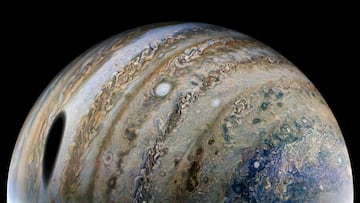
An international team of scientists from the Weizmann Institute of Science has revealed that Jupiter, the largest planet in the solar system, is a bit smaller and flatter than believed for decades. The most precise measurements to date were made possible thanks to data collected by NASA’s Juno probe, which has been studying the gas giant since 2016.
Previous estimates of Jupiter’s size and shape were based on limited data gathered nearly 50 years ago by the Voyager and Pioneer missions. By contrast, scientists were able to obtain far more accurate measurements by analyzing how Juno’s radio signals bend as they pass through the planet’s dense atmosphere.
The new findings, published in Nature Astronomy, show that Jupiter’s equatorial diameter is about 8 kilometers (5 miles) smaller than previously estimated, while its polar diameter is roughly 24 kilometers (15 miles) less than earlier calculations suggested.
Turns out Jupiter is slightly smaller and more “squashed” than we orginally thought.
— NASA Marshall (@NASA_Marshall) February 4, 2026
NASA’s Juno mission found the planet is 5 miles narrower at the equator and 15 miles flatter at the poles — key info that will help us study worlds beyond our solar system.
More 👇…
Juno redefines Jupiter’s size and shape
These observations indicate that Jupiter is more flattened than expected, with a greater difference between the size of its equator and its poles. This shape is explained by the planet’s rapid rotation and the powerful winds in its atmosphere, both of which significantly influence its physical form and cause a slight deformation that can now be measured with greater precision.
“When the spacecraft passes behind the planet, its radio communication signal is blocked and bent by Jupiter’s atmosphere. This enables an accurate measurement of Jupiter’s size,” said Dr. Scott J. Bolton, principal investigator of the Juno mission at the Southwest Research Institute in San Antonio, Texas.
This revision of the planet’s dimensions does not strip Jupiter of its title as the largest body in the solar system. However, it does require scientists and science communicators to reconsider physical models, maps, and educational materials that have relied on outdated values. As Yohai Kaspi, the study’s lead author, noted, “textbooks will need to be updated” to reflect this new understanding.
Beyond physical dimensions, these refined measurements help astronomers gain deeper insight into Jupiter’s interior, including its structure, atmospheric dynamics, and mass distribution. Improving models of Jupiter also advances our understanding of how other gas giants form and evolve, both within our solar system and beyond it.
“Jupiter was likely the first planet to form in the solar system, and by studying what’s happening inside it, we get closer to understanding how the solar system, and planets like ours, came to be,” Professor Kaspi concluded.
Related stories

Get your game on! Whether you’re into NFL touchdowns, NBA buzzer-beaters, world-class soccer goals, or MLB home runs, our app has it all.
Dive into live coverage, expert insights, breaking news, exclusive videos, and more – plus, stay updated on the latest in current affairs and entertainment. Download now for all-access coverage, right at your fingertips – anytime, anywhere.
Complete your personal details to comment