


Scientists discover mysterious red dots in space and agree: “We don’t know what it is”
Researchers are trying to determine the composition of the mysterious red dots captured by the James Webb Space Telescope.
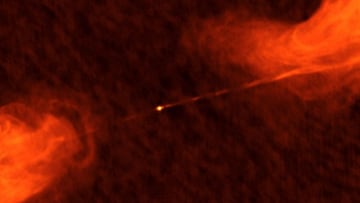
The rapid growth of supermassive black holes, astronomical objects with masses equal to millions or even billions of times that of the Sun, remains a major mystery in modern astrophysics. Since they were first observed, researchers have been working to answer key questions about how these objects form and evolve.
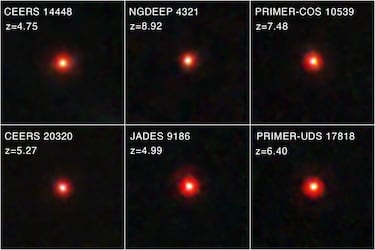
One such investigation into the so-called Little Red Dots (LRDs), named for their appearance as tiny red specks scattered across the cosmic horizon, was conducted by an international team led by the Kavli Institute for Cosmology at the University of Cambridge. The team also included contributions from the Instituto de Astrofísica de Canarias, which provided crucial data gathered by the Gran Telescopio Canarias, the world’s largest optical and infrared telescope.
According to the study, supermassive black holes are characterized by an intense reddish color, which has prompted extensive research. These red hues are not random. As the universe expands, light from the most distant objects is stretched to longer wavelengths, a phenomenon known as redshift. However, unlike conventional active galactic nuclei, LRDs appear faint in X-ray and infrared wavelengths, which challenges the expected explanation for their distinctive red color.
Findings consistent with distant sources
The Cambridge team selected one of the closest known LRDs as their subject, located several billion light-years from Earth. Using the Gran Telescopio Canarias at the Observatorio del Roque de los Muchachos in La Palma, researchers were able to uncover spectroscopic details that had been impossible to obtain from more distant examples.
The observations revealed faint signatures of ionized iron, a direct indication of extremely dense gas surrounding the black hole. This discovery allowed scientists to reinterpret signals detected from other LRDs and confirm their presence in more distant sources. Xihan Ji, the study’s lead author, explained that these findings will help researchers reconstruct the conditions that may have enabled the rapid growth of these objects.
Cristina Ramos Almeida, a researcher at both the Instituto de Astrofísica de Canarias and the Universidad de La Laguna, cautions that this is only the beginning of a much larger effort. She noted that the team has secured an additional 30 hours of observation time with the Gran Telescopio Canarias to expand their sample size and triple current data. Even so, much work remains to fully unravel the mysteries surrounding LRDs, and studies on their formation and evolution continue in research centers around the world.
Related stories
Get closer to the game! Whether you like your soccer of the European variety or that on this side of the pond, our AS USA app has it all. Dive into live coverage, expert insights, breaking news, exclusive videos, and more. Plus, stay updated on NFL, NBA and all other big sports stories as well as the latest in current affairs and entertainment. Download now for all-access coverage, right at your fingertips – anytime, anywhere.
And there’s more: check out our TikTok and Instagram reels for bite-sized visual takes on all the biggest soccer news and insights.
Complete your personal details to comment