


Scientists venture into a cave and discover the mother of all spider webs: a city of 100,000 inhabitants straddling two countries
Discovered in 2022, the subterranean spider web spans over 1,000 feet and is home to a six-figure population of arachnids.
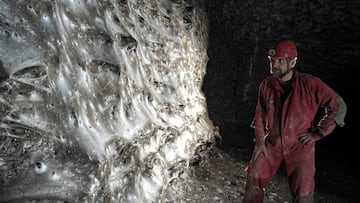
If you suffer from arachnophobia, you may wish to look away now. In 2022, researchers from the Czech Speleological Society stumbled across the world’s largest spider web, while exploring a chemoautotrophic sulfidic ecosystem in a cave on the Albania-Greece border.
The huge, silken web, which spans over 1,040 square feet - nearly half the size of a tennis court - was the fruit of the labor of two spider species working together.
Species build “mega city” together
A joint venture by Tegenaria domestica, commonly known in the U.S. as the barn funnel weaver or domestic house spider in Europe, and the smaller Prinerigone vagans (sheet weavers or money spiders), the giant web is home to about 111,000 spiders from both species.
The domestic house spider is the dominant spider species in the colony, comprising an estimated 69,000 individuals, while their neighbors, the sheet weaver community, is calculated at around 42,000.
A European first
The cave has presented researchers with the first known European example of parasocial or colonial behavior - cooperation in web building by two different species sharing the same space. Until now, there had been only one documented case of sub-social behavior in cave-dwelling spiders - observed inside the Gruta Casa de Pedra cave, in Brazil’s Alto Ribeira Tourist State Park, in 2009.
Most spider species are solitary, which it is why it’s unusual to come across such a large population existing together and sharing the same communal web.
Finding food in the dark
In such a hostile environment - a pitch black cave filled with hydrogen sulfide gas, scientists wondered where such a large population of spiders would source their food. They found that the arachnids feed on tiny midges that hatch from cave pools.
Three other spider species were found to be present in the cave: long-jawed orb weavers (Metellina merianae), dwarf spiders (Lepthyphantes magnesiae), and tangle-web spiders (Kryptonesticuseremita). However, as non-colony-forming critters, they tend to keep themselves to themselves and live far away from the giant, communal “supercity” web.
Related stories


Get your game on! Whether you’re into NFL touchdowns, NBA buzzer-beaters, world-class soccer goals, or MLB home runs, our app has it all.
Dive into live coverage, expert insights, breaking news, exclusive videos, and more – plus, stay updated on the latest in current affairs and entertainment. Download now for all-access coverage, right at your fingertips – anytime, anywhere.
Complete your personal details to comment