


Special 6,000-year-old burial of two sisters, a baby and a dog discovered in a mine in the Czech Republic
Scientists have lifted the lid on the discovery of two female skeletons inside a Neolithic-era chert-mining shaft.
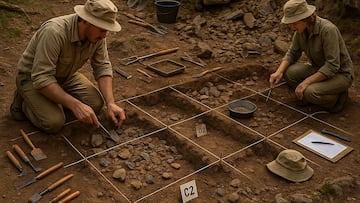

Six-thousand-year-old skeletons found recently in the Czech Republic might belong to individuals who were buried as part of an ancient “reconciliation” ritual, researchers say.
In a study published this month in the journal Archaeological and Anthropological Sciences, a team of Czech archaeologists has lifted the lid on the discovery of two adult female skeletons inside a Neolithic-era chert-mining shaft.
Where was the discovery made?
Found in the Krumlov Forest, home to one of prehistoric Europe’s largest mining fields, the skeletons appear to belong to sisters who lived at some point between 4300 and 4000 BCE, the researchers say.
“One can only speculate”
Curiously, the skeleton of a newborn child was also found lying on the chest of one of the women. However, tests showed that the baby was not related to either adult.
“One can only speculate as to why the newborn was buried together with the females,” the archaeologists say. “It is not excluded that the child died in the same time frame.” In addition to the three humans, the skeletal remains of a dog were also discovered close by.
The women endured a tough existence
Although the precise cause of death could not be ascertained for any of the buried individuals, the researchers say their analysis of the women’s skeletons offers up evidence that they “did not have an easy life”.
“Both of them repeatedly experienced several, apparently febrile, illnesses in childhood, which were manifested by non-specific signs of stress on the skeletons […],” reads the Archaeological and Anthropological Sciences paper.
“In adulthood, they disproportionately overloaded their spines, especially the lumbar sections, by carrying heavy loads and probably by working in a forward bend.”
What did the women look like?
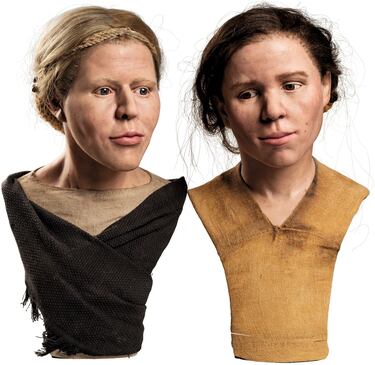
The scientists have also offered insight into the women’s external appearance, by completing a 3D reconstruction based on factors including a “thorough study of the dimensions and shapes of the skull”.
One woman is thought to have been about 30 to 35 years old, with brown or green eyes and dark hair. The other is believed to have been 35 to 40, probably with blue eyes and fair hair.
Forced laborers in symbolic burial?
While it seems the women worked in the mine, investigators say it is unclear whether or not they did so voluntarily.
The researchers add that the choice of burial location may have been part of a symbolic mining ritual that sought a form of “reconciliation” with the surrounding environment: “Anything reminiscent of the miners’ activities is returned to the earth, sometimes including the miners themselves. And that may be the case with these females.”
You can read the study in full in Archaeological and Anthropological Sciences.
Related stories


Get your game on! Whether you’re into NFL touchdowns, NBA buzzer-beaters, world-class soccer goals, or MLB home runs, our app has it all.
Dive into live coverage, expert insights, breaking news, exclusive videos, and more – plus, stay updated on the latest in current affairs and entertainment. Download now for all-access coverage, right at your fingertips – anytime, anywhere.
Complete your personal details to comment