


Stephen Hawking, scientist: “Intelligence is the ability to adapt to change”
The English astrophysicist was much more than a scientist. His discoveries and reflections on the future of humanity made him a leading voice of his time.
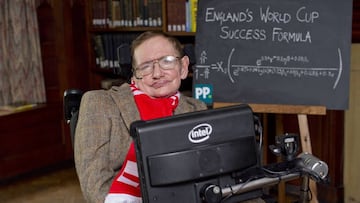
Stephen Hawking is widely regarded as one of the most influential scientists in modern history. He devoted his life not only to unraveling the mysteries of the universe, but also to reflecting on philosophical and psychological questions.
A brilliant mind, he was always deeply interested in the human brain and in personal development. That interest shaped his view of intellect and adaptability. “Intelligence is the ability to adapt to change,” Hawking famously said. He also had a sharp response for those who brag about being smart: “People who boast about their IQ are losers.”
Born in Oxford in 1942, Hawking became a global icon in theoretical physics and cosmology. His research on black holes, especially his prediction of the radiation that now bears his name, transformed our scientific understanding of the cosmos.
At age 21, Hawking was diagnosed with amyotrophic lateral sclerosis (ALS), a neurodegenerative disease that gradually limited his mobility and ability to speak. Yet for decades, he defied medical expectations. Rather than retreating from public life, he used his personal experience to advocate for the importance of knowledge, international cooperation, and space exploration as tools for humanity’s survival.
Quiet people have the loudest minds.
— Vala Afshar (@ValaAfshar) December 1, 2024
—Stephen Hawking pic.twitter.com/Q66hArl8I6
A commitment to space exploration
For Hawking, expanding into space was not a science-fiction fantasy. It was a necessity. He argued that exploring and eventually colonizing other celestial bodies could help ensure the long-term survival of human life. “We must continue to go into space for the future of humanity,” he insisted, emphasizing that scientific ingenuity must be matched by ethical responsibility. The subject remains especially timely today, with NASA’s plans to send new missions to the Moon drawing renewed global attention.
Related stories
Beyond his scientific work, Hawking also stood out as an extraordinary communicator. Books such as A Brief History of Time brought complex ideas to a broad audience and strengthened his role as a global thinker. His legacy is not limited to equations and theories. It also lives on in a powerful message: knowledge is our best tool for survival.
Stephen Hawking died in 2018, but his words continue to resonate as both a warning and a challenge. In his view, looking to space was never just about curiosity. It was a commitment to the future of humanity.
Complete your personal details to comment