


The colossal hydroelectric dam built in 1970 has a wall worthy of ‘Game of Thrones’
The Almendra Dam, is among the largest in terms of capacity and is the tallest in all of Spain, standing over 660 feet and a third of a mile long.
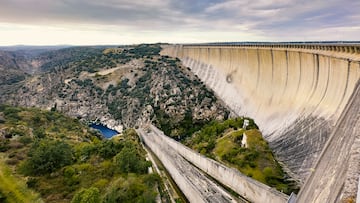
The past few weeks, marked by heavy rainfall across much of the Iberian Peninsula, have eased Spain’s water situation. Reservoirs nationwide are now above 75 percent capacity, holding more than 35 million acre feet (MAF) of water, more than double the entire annual allocation of the Colorado River Basin.
This figure is very close to the maximum capacity of Spain’s 374 reservoirs, which together can store up to 45.4 MAF. At this same point last year, the percentage stood at just over 58 percent.
According to the inventory of the Ministry for the Ecological Transition and the Demographic Challenge, Spain has more than 2,000 dams, both large and small. While many are identical or very similar and serve the same purpose, others stand out for specific reasons.
One such example is the Almendra Dam, located on the Tormes River between the municipalities of Almendra in Salamanca and Cibanal in Zamora.
This structure stands out for its enormous scale. Also known as the Villarino drop, it is the tallest dam in Spain at a little more than 660 feet high and more than a third of a mile long (1860 feet), and its reservoir ranks third in capacity with almost 2.15 MAF.
It is an arch dam, and its construction between 1964 and 1970 required the excavation of 1.5 million metric tons of material. This made room not only for the dam itself but also for the 33 square miles covered by the reservoir.
The great concrete wall worthy of ‘Game of Thrones’
It is estimated that more than 2.4 million metric tons of concrete were used in its construction, making it one of the largest hydroelectric engineering projects ever built in Spain. Newspapers at the time estimated its cost at between 4 and 10 billion pesetas, equivalent to roughly 57 to 143 million dollars in 1970.
It is also one of the largest dams in Europe, which earned it the nickname the ‘Sea of Castile’. However, the facilities include more than just the reservoir.
They also feature a conduit connecting to the Duero River and a hydroelectric power plant. This consists of a nearly 10-mile tunnel with a diameter of more than 24.5 feet, excavated through rock and lined with concrete.
The power plant was built in the municipality of Villarino de los Aires, which is where its popular name comes from. In this town, the residential settlements of La Rachita and Santa Catalina were constructed to house plant workers.
The project was a remarkable feat of engineering, with turbines that are not located at the foot of the dam. These turbines serve a dual purpose. They rotate to generate electricity, but they can also operate in reverse to pump water, moving up to 61,288 gallons per second.
Its construction, however, was not without controversy. To make way for the dam, nearly 400 residents of Argusino were forced to leave their homes. The village was ultimately submerged by the reservoir’s waters, and its municipal territory was divided between the municipalities of Villa del Buey and Salce in 1968.
Related stories
Get your game on! Whether you’re into NFL touchdowns, NBA buzzer-beaters, world-class soccer goals, or MLB home runs, our app has it all.
Dive into live coverage, expert insights, breaking news, exclusive videos, and more – plus, stay updated on the latest in current affairs and entertainment. Download now for all-access coverage, right at your fingertips – anytime, anywhere.
Complete your personal details to comment