


The day nine students changed America forever: Remembering Little Rock’s civil rights breakthrough
On Thursday, September 25, it will be exactly 68 years since nine Black students began classes at Little Rock Central High School.
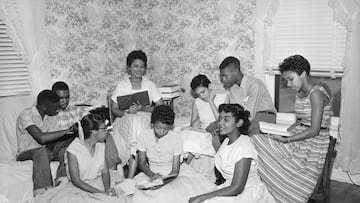

Sixty-eight years ago this week, nine Black students in Arkansas began attending a previously all-white high school under armed guard, in a moment in U.S. history that became a national symbol of the struggle for civil rights and school desegregation.
Known as the “Little Rock Nine”, the group of students joined classes at Little Rock’s Central High School on September 25, 1957 - 22 days after term had begun.
Over the preceding three weeks, a combination of the Arkansas National Guard and a baying mob of segregationists had repeatedly stymied their attempts to commence their studies.
Who are the Little Rock Nine?
The students - Ernest Green, Elizabeth Eckford, Jefferson Thomas, Terrence Roberts, Carlotta Walls Lanier, Minnijean Brown Trickey, Gloria Ray Karlmark, Thelma Mothershed-Wair and Melba Pattillo Beals - had enrolled at Central High on the back of a U.S. Supreme Court ruling that deemed racial segregation in public schools to be unconstitutional.
“Explosive for the community”
In the days after the Supreme Court’s 1954 decision, the Little Rock school board said it would comply with the ruling. But “this idea was explosive for the community and, like much of the South, it was fraught with anger and bitterness,” notes the National Museum of African-American History and Culture.
Three years on, as Black students finally prepared to attend Central High School on September 3, 1957, Arkansas Governor Orval Faubus deployed members of the state’s National Guard to make sure their way in was blocked. Faubus claimed he had made the decision for the Little Rock Nine’s safety, saying on local TV that he was trying to prevent “blood in the streets”.
The Black students then unsuccessfully tried to enter Central High in the days that followed, amid pro-segregation protests that spawned an iconic, Pulitzer-nominated photograph of a white student, Hazel Bryan, angrily heckling Eckford as she approached the school on September 4.
On September 23, the Black students made it into the school via a side door, under the protection of Little Rock police. However, with their lives deemed under threat by a “hysterical” crowd of 1,000 white protesters gathered outside, the Little Rock Nine were soon rushed away in police cars.
Arkansas Democrat staffer Will Counts photographed Hazel Bryan screaming insults at Elizabeth Eckford outside Central High School in Little Rock on September 4, 1957. Eckford and eight other Black students endured harassment from white students the entire school year. pic.twitter.com/MlJsEn9psP
— Karl Gehring (@karlgehring) September 4, 2025
“Mob rule cannot be allowed to override decisions of courts”
It wasn’t until September 25, when President Dwight Eisenhower sent in federal troops from the U.S. Army’s 101st Infantry Division to protect the Black students, that the Little Rock Nine were able to start attending regular classes at Central High. “Mob rule cannot be allowed to override the decisions of our courts,” Eisenhower told a White House address after intervening in the crisis.
The troops remained at Central High throughout the school year, but it didn’t stop the Little Rock Nine from enduring continued abuse. “They were taunted, assaulted and spat upon by their white counterparts; a straw effigy of a black person was hung from a tree,” says The Guardian’s David Smith.
“It was like going to war every day,” Green told an interview with the Associated Press in 2017. “You had students who tried to use as much verbiage as they could to intimidate us. We had threats and comments that we would be killed. But we decided that this was a year that we were going to support each other - we were going to try to do as well as we could in our academic work.”
In May 1958, Green - who was the only senior among the Little Rock Nine - became the first Black student to graduate from Central High School.
Little Rock Nine honored by Congress
In November 1999, the Little Rock Nine were presented with the Congressional Gold Medal - the highest civilian award in the U.S. - “in recognition of the selfless heroism they exhibited and the pain they suffered in the cause of civil rights”.
A year before the group received the Gold Medal, Congress also declared Little Rock Central High School a National Historic Site.
Located next to the school, a visitor center “commemorates the 1957 desegregation crisis and preserves the stories of the Little Rock Nine, their families, and community members who shaped this pivotal moment in the Civil Rights Movement,” says the National Park Service, which runs the site.
“Through education and engagement, the site encourages reflection on past struggles and the continuing pursuit of civil rights in the United States.”
This Thursday, the Central High School National Historic Site is to mark the 68th anniversary of Black students’ entrance in the school, by holding a commemorative event at Philander Smith University, from 7:00 p.m. The event’s speakers will include members of the Little Rock Nine.
Related stories


Get your game on! Whether you’re into NFL touchdowns, NBA buzzer-beaters, world-class soccer goals, or MLB home runs, our app has it all.
Dive into live coverage, expert insights, breaking news, exclusive videos, and more – plus, stay updated on the latest in current affairs and entertainment. Download now for all-access coverage, right at your fingertips – anytime, anywhere.
Complete your personal details to comment