


The historic district where rent is $1 a year on the condition that you pray three prayers a day
Living in the Fuggerei neighborhood in Augsburg, Germany, imposes the condition of saying three prayers a day.

When searching for affordable housing, we might be looking in the wrong city—or even the wrong country. Imagine hearing about a neighbourhood in Europe with the oldest social housing, dating back 500 years, where you can live for just $1 a year. You’d want to move there immediately—and start learning German the next second.
This is Fuggerei, a historic German neighbourhood where tradition dictates that residents also pay the local priest the same amount as their rent—yes, $1. There is one more longstanding condition for living within these centuries-old walls: residents are expected to pray the Lord’s Prayer, the Hail Mary, and the Apostles’ Creed.
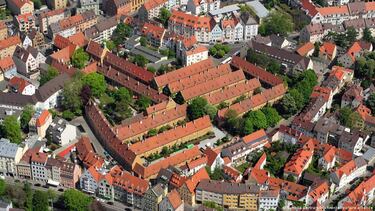
The Fuggerei complex consists of 142 houses, home to 134 residents (90 women and 44 men). It was founded in 1521 by Jakob Fugger—hence the name—for the poorest citizens of Augsburg. Fugger, a banker and advisor to Maximilian I, created the neighbourhood with an annual rent of one Rhenish florin, equivalent to around 88 euro cents today.
The requirements for living at Fuggerei have remained essentially unchanged: residents must be Catholic, in need of financial assistance, and have lived in Augsburg for at least two years. Most residents are elderly and in vulnerable situations, though there are discussions about opening the complex to younger generations and even families.
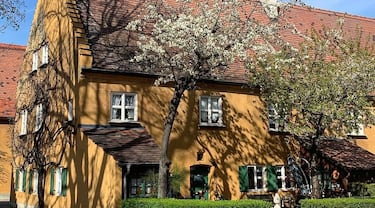
The waiting list for a home here stretches for years. The current complex comprises 67 terraced houses covered in stucco and ochre-coloured ivy, all within a walled enclosure near the city’s medieval centre—a dream for many. In fact, Ursula von der Leyen, President of the European Commission, travelled from Brussels to visit the project and address dignitaries in Augsburg’s Golden Hall for the Fuggerei’s 500th anniversary. She suggested it could inspire the reconstruction of war-torn Ukraine and pledged to raise the idea with President Volodymyr Zelensky. Europe, she added, needed “more Fuggereis.”
Each apartment, rebuilt and modernised with electricity and plumbing after World War II damage, has a private entrance, each with a unique doorbell. The complex also features communal spaces, including a Baroque chapel, an outdoor beer garden, and a dining room where weekly breakfasts and regular entertainment are provided free of charge. Residents range from seven months to 93 years old, and all are welcome to stay as long as they wish. Few leave before requiring round-the-clock care.
The 10:00 p.m. curfew, originally established to protect residents from unruly drunks, remains in effect. Those found outside after that time must pay a fine of up to €1 to re-enter, depending on the delay.
Related stories


Attempts to replicate Fuggerei’s model exist worldwide, but none have truly succeeded. The appeal lies in localism, sustainability, self-realisation, and thoughtfully shared living space. Perhaps it is the desire to protect and support one another—or the awareness of being part of a living historical legacy. Ultimately, it is the pursuit of genuine community for the common good, reflecting the Latin root of the word: communitas.
Get your game on! Whether you’re into NFL touchdowns, NBA buzzer-beaters, world-class soccer goals, or MLB home runs, our app has it all. Dive into live coverage, expert insights, breaking news, exclusive videos, and more – plus, stay updated on the latest in current affairs and entertainment. Download now for all-access coverage, right at your fingertips – anytime, anywhere.
Complete your personal details to comment