


80 years ago today the USS Indianapolis was sunk in the Pacific. What followed was a nightmare from which only a third of the men emerged alive.

The nightmare of the USS Indianapolis crew: Inside the largest shark attack in human history

On July 16, 1945, the heavy cruiser USS Indianapolis departed from San Francisco on a secret mission that would ultimately help decide the war. Its destination was Tinian Island in the Marianas, where it was to deliver components of the atomic bomb Little Boy. To ensure secrecy and speed, the cruiser—one of the fastest in the U.S. Navy—traveled unescorted and at the maximum speed its newly repaired engines could handle.
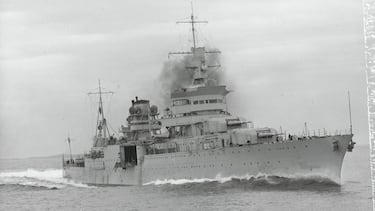
USS Indianapolis sunk in 12 minutes
The USS Indianapolis reached its destination on July 26 and, after unloading its valuable cargo, headed toward Leyte in the Philippines to join the fleet preparing to invade Japan.
Everything went wrong in the early hours of July 30. Captain Charles B. McVay III ordered the ship to stop zigzagging, a standard anti-submarine maneuver, due to low visibility from fog and to increase speed. At that moment, the Japanese submarine I-58 fired two torpedoes, hitting the American vessel. The cruiser broke in two and sank in just 12 minutes. Of the 1,196 men on board, about 900 managed to abandon ship and were left adrift, with no one knowing where they were or able to help. That’s when the real nightmare began.
The most dangerous sharks
The charred bodies, the blood of the dead and wounded, the noise, and the movement in the water attracted dozens of sharks. Most were Oceanic whitetip sharks. These are sharks between 10 and 13 feet long that become extremely aggressive when in a feeding frenzy. In fact, the legendary oceanographer Jacques Cousteau considered them “the most dangerous sharks.”
The ship sank so quickly that many survivors were thrown into the sea without life jackets and had to cling to debris. Sailor Woody James later recalled, “There I was, floating without a life jacket, when suddenly an empty wooden box floated by. I grabbed onto it.” When he was rescued, he was still holding onto that box. There was no time to lower lifeboats, and only a few rubber rafts remained usable. Most of the sailors floated without drinking water, without food, under a scorching sun by day and freezing cold at night. They endured four hellish days.
Heroes, madness and hallucinations
Shark attacks began immediately. “It was a nightmare. You’d see someone next to you, and the next second they were gone,” said Edgar Harrell, one of the survivors. The men grouped together to try to defend themselves from the attacks, but when someone drifted away or was left alone, they were attacked and devoured almost instantly.
As the days passed, some drank seawater, which caused madness and hallucinations. Harold Bray remembered, “One of them told me he saw a freshwater spring at the bottom of the ocean. He dove down and never came back.” There were also acts of heroism, like that of Chaplain Thomas Conway, who swam from group to group trying to lift the survivors’ spirits until a shark took him. Or Lieutenant Lewis Haynes, the ship’s doctor, who tirelessly spent the four days helping the wounded and treating them as best he could: “We couldn’t do much, but we tried to keep each other alive.”
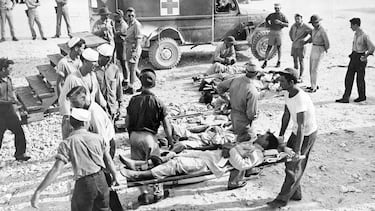
Desperate rescue
No one knew what was happening. No one was looking for the Indianapolis. Its rescue was pure chance. On August 2, four days after the sinking, a U.S. Navy Lockheed Ventura spotted an oil slick in the sea. As it approached, it discovered the ocean full of floating men, dropped an inflatable raft, and sent out an SOS.
A Catalina seaplane received the message. Its pilot, Lieutenant Adrian Marks, was horrified by what he found and landed on the water, disobeying orders and risking his life. He began picking up survivors. When the plane was full, as a last resort, he tied more men to the wings with ropes to keep them out of the water and away from the sharks. The plane, overloaded and damaged by the waves, didn’t even attempt to take off, but it kept 56 men alive until the USS Doyle arrived—the first ship to reach the scene of the tragedy.
In total, 316 men were rescued alive from the roughly 900 who had managed to abandon ship after the Japanese attack. Between 500 and 600 died from injuries, thirst, madness, or the four days of relentless shark attacks, driven by the feast and the blood.
Get your game on! Whether you’re into NFL touchdowns, NBA buzzer-beaters, world-class soccer goals, or MLB home runs, our app has it all.
Related stories


Dive into live coverage, expert insights, breaking news, exclusive videos, and more – plus, stay updated on the latest in current affairs and entertainment. Download now for all-access coverage, right at your fingertips – anytime, anywhere.
Complete your personal details to comment