


The search for gold in space: Scientists say they’ve discovered a surprising new source in the cosmos
The gold you wear today may have landed on Earth billions of years ago... but that is far from the beginning of the metal’s journey, according to this new study.
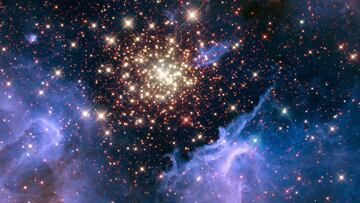

Though we might not give it much thought, the origins of gold tell a story that began billions of years ago.
However, the exact way gold and other heavy elements formed within the vast history of the universe has remained a mystery until recent years. After the Big Bang, it would take millions of years for stars to form, and then for some to die, which is where gold enters the celestial timeline.
A recent study published in The Astrophysical Journal Letters points to the existence of megentar giant flares, on neutron stars, as one of the sources of elements heavier than iron, of which gold is one, in our galaxy.
But first, let’s look at a couple of definitions and celestial objects that help to explain gold’s origins.
A neutron star is the incredibly dense remnant left behind after a massive star dies in a supernova explosion. Not all stars end this way; for example, our Sun is too small to become a neutron star. Instead, it will eventually become a white dwarf.
Our @NASAHubble Space Telescope detected an unusual infrared light radiating from a nearby neutron star, which forms when a massive star runs out of fuel and collapses. But could these be new features never before seen? Find out the possibilities: https://t.co/dBFmxF07tG pic.twitter.com/B3mulQ0uL0
— NASA (@NASA) September 18, 2018
Depending on its mass, the core can collapse into either a neutron star or, if it’s even more massive, a black hole. However, when looking at neutron stars, the new study highlights the role of magnetars, which NASA defines as “a neutron star with an extremely powerful magnetic field,” in creating and dispersing heavy metals throughout the universe.
Like black holes, neutron stars are extremely dense and have a strong gravitational pull. NASA emphasizes the significance of the new findings by highlighting research from 2017 that demonstrated how the collision of two neutron stars could result in the formation of heavy metals. After observing a neutron star collision, the astronomers “confirmed that this event could have created gold, platinum, and other heavy elements,” reported the US space agency.
When a binary neutron star collision creates short gamma-ray bursts, some of the heaviest elements found on Earth, like gold and platinum, are produced. Recently deployed from the @Space_Station, our BurstCube satellite may help us learn about their creation during these events. pic.twitter.com/72t6k1MpF0
— NASA Universe (@NASAUniverse) May 13, 2024
There is one problem: many astronomers believe heavy metals formed before any neutron stars would have collided. In other words, there must be another way these materials were formed. Enter magnetar flares. In their groundbreaking article released on April 29, the researchers found that these flares “can heat and eject neutron star crustal material at high speeds, making them a potential source,” of gold and other heavy elements.
So, how do these metals get to Earth?
After these explosions take place, gold particles begin to travel through space. Our Earth began to form over 4.5 billion years ago, around the same time the Sun was taking shape. As the Sun formed, its gravitational pull drew in material from the surrounding cloud of gas and dust, pulling it into orbit. This material eventually clumped together to form the planets.
But it might not have been during Earth’s initial formation that gold and other heavy metals found a lasting home in the crust. Instead, the NCESC Geographic FAQ points to a period known as the Late Heavy Bombardment, which occurred roughly between 4.0 and 3.8 billion years ago. During this time, Earth was struck by a barrage of meteors and asteroids—many of which carried heavy elements, including gold. These cosmic collisions likely delivered much of the gold we find in Earth’s crust today.
Related stories
By this point in Earth’s development, a solid crust had already formed, which helped preserve the gold near the surface. In contrast, any gold present during Earth’s early molten phase likely sank into the core. As a dense, heavy element, gold would have been pulled downward by gravity while the planet was still molten, making it difficult for it to remain near the surface once the crust solidified.
Get your game on! Whether you’re into NFL touchdowns, NBA buzzer-beaters, world-class soccer goals, or MLB home runs, our app has it all. Dive into live coverage, expert insights, breaking news, exclusive videos, and more – plus, stay updated on the latest in current affairs and entertainment. Download now for all-access coverage, right at your fingertips – anytime, anywhere.
Complete your personal details to comment