


The secret of the 11 atomic bombs the United States has lost around the world and no one knows where they are
According to existing documentation, the U.S. military has lost nearly a dozen nuclear bombs, but some analysts suggest the number could be higher: “There’s still a lot we don’t know about the nuclear weapons program—and probably never will.”

In life, we all lose things—and sometimes things that seem very important. A pen, keys, a phone… But everyone loses according to their means, and in the U.S., they know better than anyone what it means to lose big. To this day, they have as many as 11 atomic bombs that are missing. Some of them are more or less located and could potentially be recovered, but the risk of causing a radioactive leak or an accident during retrieval is high enough that authorities have chosen not to pursue them.
Moreover, the number could be even higher, according to Stephen Schwartz, a nuclear security expert: “The U.S. government has never been fully transparent about the number and fate of its lost nuclear weapons.” “There’s still a lot we don’t know about the nuclear weapons program—and probably never will.”
The most high-profile case occurred on Tybee Island, off the coast of Georgia (U.S.), just 20 miles from Savannah. On February 5, 1958, a B-47 bomber and an F-86 fighter jet collided in midair during a nighttime training exercise. The B-47 was carrying a 7,500-pound Mark 15 thermonuclear bomb. The B-47’s commander attempted an emergency landing and was granted permission to jettison the bomb. He dropped it from an altitude of 7,200 feet over Wassaw Sound, a relatively small and shallow bay where recovery seemed feasible.
The Navy and Air Force searched a 15-square-mile area for two months without success and were unable to locate the bomb. In April, the government gave up and declared the bomb irretrievable.
In 2004, Derek Duke, a retired Air Force lieutenant colonel, organized a private search for the bomb. They didn’t find it, but they did detect a spot with elevated radiation levels. They assumed the bomb was there, buried under several feet of sediment. However, the U.S. Department of Energy stated that the elevated levels were natural and unrelated to the bomb, which remains missing.
Hanging by a wire from catastrophe
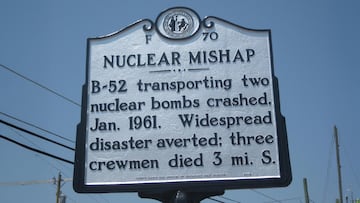
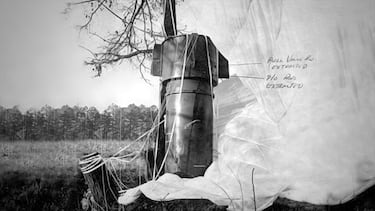
An even more serious incident involved a B-52G that broke apart mid-flight while carrying two 3.8-megaton Mark 39 thermonuclear bombs over Goldsboro, North Carolina, on January 24, 1961. Five of the eight crew members survived, but the bombs fell to the ground. One sank into a muddy swamp, while the other deployed its parachute and got caught in a tree.
Although the entire story sounds disastrous, the outcome was nothing short of miraculous. Three of the four safety mechanisms on the tree-hanging bomb failed, and it didn’t detonate only because two wires in a low-voltage switch failed to connect. Had it worked properly, the explosion would have been 260 times more powerful than the bomb dropped on Hiroshima—in a densely populated area of the U.S.
The problems didn’t end there. Some components of the bomb that sank into the mud were recovered, but most of it remained buried. The government purchased the land, fenced it off, and decided not to dig further due to the risk of spreading radioactive material. And to this day, it remains there, several feet underground, with no one daring to attempt its recovery.
Operation Chrome Dome
Between 1960 and 1968, the United States launched a series of missions known as Chrome Dome. These involved continuous flights of B-52 strategic bombers armed with nuclear bombs. They patrolled near Soviet airspace to ensure an immediate response in the event of a nuclear attack. The program was suspended after several serious accidents.
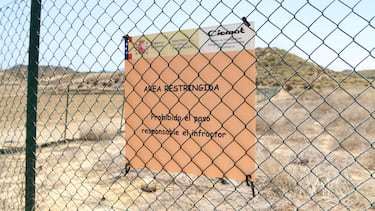
The first occurred in Palomares, Spain, on January 17, 1966. A B-52 collided with a refueling aircraft and dropped four B28 nuclear bombs. Two hit the ground and their conventional explosives detonated, spreading radioactive material across the area. A third bomb landed intact and was recovered without damage. The fourth fell into the sea and was initially located at a depth of 1,000 feet in early February. During recovery, it slipped from the cable due to the weight of the deployed parachute underwater and sank again—this time to a depth of 2,850 feet. After what was, for the time, an almost science-fiction-like operation, it was recovered on April 7.
The second Chrome Dome accident occurred in Thule, Greenland, on January 21, 1968. A B-52G crashed onto the ice of North Star Bay, and three of its four bombs experienced conventional explosions that destroyed their nuclear components and scattered radioactive material across the area. However, the fourth bomb was never found. No one knows whether it sank to the bottom or became trapped in the ice—and it could one day emerge inside an iceberg.
The plane that forgot the brakes
Several of these incidents remain classified or lack official confirmation. Most involve accidents in various seas—the Arctic, the Mediterranean, the Pacific—where the bombs were never recovered. Some cases are especially mysterious. According to expert analysis based on limited declassified documents, one such incident occurred somewhere within the U.S. during the 1960s. A bomb fell to the ground and could not be recovered due to the risks involved, but the location remains undisclosed and all related information is still classified.
There is an even more opaque case that remains highly classified. It is speculated to involve covert operations or major security failures, but no public evidence has ever surfaced. It is mentioned in U.S. Department of Defense documents, but without further details.
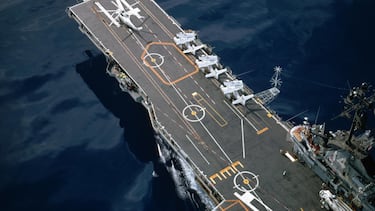
And then there’s the most absurd case. On December 5, 1965, a Douglas A-4E Skyhawk loaded with a 1-megaton B43 thermonuclear bomb was being moved from its hangar to elevator number 2 aboard the aircraft carrier USS Ticonderoga. Due to a mishap, the plane kept rolling slowly while the crew signaled the pilot, Lieutenant Douglas M. Webster, to stop. Unfortunately, he didn’t understand the signals, and the plane rolled off the deck. The pilot, the aircraft, and the bomb all sank to the bottom of the Philippine Sea—at a depth of 16,000 feet—and were never recovered.
The incident occurred just over 60 miles off the coast of Japan, which filed a diplomatic protest with the U.S. over the presence of nuclear weapons in waters near its territory.
According to Jaya Tiwari, a researcher at the Center for Defense Information in Washington: “Some of these accidents were more dangerous than one might suspect.”
Today, there are 12,241 documented nuclear warheads in the world. Let’s hope no one ever loses another—because if losing your keys is already a problem, losing a nuclear bomb should be, at the very least, unforgivable.
Get your game on! Whether you’re into NFL touchdowns, NBA buzzer-beaters, world-class soccer goals, or MLB home runs, our app has it all.
Related stories


Dive into live coverage, expert insights, breaking news, exclusive videos, and more – plus, stay updated on the latest in current affairs and entertainment. Download now for all-access coverage, right at your fingertips – anytime, anywhere.
Complete your personal details to comment