


This was the ‘anti-D-Day’: the U.S. landing in World War II that led to hundreds of deaths before Normandy
Slapton Sands is the British beach that was used to simulate Normandy, where everything went wrong during ‘Exercise Tiger’ just weeks before the actual attack.
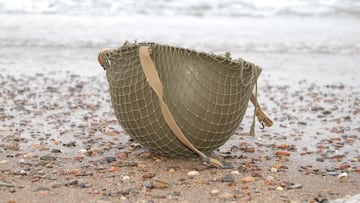

On June 6, 1944, Allied troops landed in Normandy in the most decisive operation of World War II. However, five weeks earlier, a disastrous rehearsal took place, resulting in hundreds of deaths and nearly leading to the cancellation of D-Day. It was called ‘Exercise Tiger.’
In the months leading up to the landing in France, Allied forces conducted a series of rehearsals on various beaches in England with terrain similar to that of Normandy. To prepare for the landing on Utah Beach, Slapton Sands and Torcross—two beaches near Plymouth—were chosen. For this purpose, by the end of 1943, more than 3,000 people and 180 farms in the area had to be evacuated. That’s when the first casualty occurred: an elderly man who refused to leave his home and took his own life.
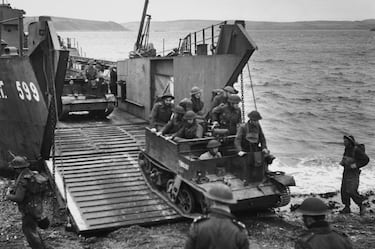
A live-ammunition exercise
Exercise Tiger began on April 22, 1944, involving the U.S. 4th Infantry Division and several support units. Until April 25, orders were distributed, training drills were conducted, and 30,000 soldiers were embarked on nine Landing Ship Tanks (LSTs), from which landing craft would be deployed. They were to be escorted by the British Royal Navy destroyer Scimitar, the Azalea, and several torpedo boats and gunboats.
On April 26, a simulated crossing of the English Channel through Lyme Bay was carried out, and problems began. The Scimitar was rammed by another ship and had to leave the exercise. However, U.S. forces were unaware of this because the British and Americans were operating on different radio frequencies.
By order of General Eisenhower, the entire exercise was to be conducted with live ammunition so that the troops could get used to fighting in an environment as close as possible to what they would face in Normandy.
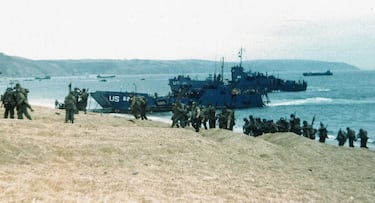
Friendly fire massacre
The landing operation was scheduled to begin on April 27 at 7:30 a.m., with a beach bombardment fifty minutes before the troops arrived. Several ships didn’t arrive on time, so U.S. Admiral Don P. Moon (who died by suicide three months later due to combat fatigue) delayed the start of the exercise by 60 minutes. The schedule change didn’t reach all the ships due to further communication problems. The synchronization between the landing and the artillery attack broke down, and the second wave suffered a heavy bombardment on the beach. Depending on the source, between 120 and 450 soldiers were killed.
Despite the casualties, the operation continued, and the remaining waves were being landed without further incidents—until nightfall. At 2 a.m. on the 28th, nine German E-Boats—fast torpedo boats—emerged from the fog and sank two LST landing ships and set another on fire. A fourth was damaged by friendly fire, while the convoy’s only protection, the corvette Azalea, again experienced communication issues and couldn’t warn of the attack in time. It was also then that it was discovered that the destroyer Scimitar was no longer in a position to protect the convoy. Another destroyer, the Saladin, was sent immediately, but it arrived after the disaster had already unfolded.
Deadly life jackets
A total of 749 Allied personnel died in the German attack—198 sailors and 551 soldiers, most of them from the 1st Engineer Brigade. Many died from hypothermia in the freezing waters. When rescuers arrived, they were horrified to discover that many others had drowned because they didn’t know how to properly wear their life jackets. They had strapped them around their waists instead of their necks, and when they hit the water, the weight of their backpacks flipped them face down, making it impossible to turn over.
Ten officers who knew all the details of the D-Day landing plan went missing during the attack. There were fears that one of them might have been picked up by the Nazis and interrogated. Eisenhower nearly canceled D-Day, fearing the Germans had learned the entire operation. He didn’t give the green light to proceed until it was confirmed that all ten bodies had been recovered.
Higher death rate than on D-Day
To understand the scale of the disaster,, in Normandy, 156,177 Canadian, American, and British troops landed, and 4,414 Allied soldiers died. In Exercise Tiger, 30,000 American soldiers participated, and depending on the source, between 946 and 1,200 died, when adding together the casualties from friendly fire and the German attack. The death rate was likely higher.
Despite the tragedy, Exercise Tiger helped identify critical failures in planning and coordination. Communication protocols were improved, naval escorts were reinforced, landing procedures were revised, and training on life jacket use was enhanced. Many historians agree that, although costly, the failure of this rehearsal was crucial to the success of the real D-Day.
Get your game on! Whether you’re into NFL touchdowns, NBA buzzer-beaters, world-class soccer goals, or MLB home runs, our app has it all.
Related stories

Dive into live coverage, expert insights, breaking news, exclusive videos, and more – plus, stay updated on the latest in current affairs and entertainment. Download now for all-access coverage, right at your fingertips – anytime, anywhere.
Complete your personal details to comment