


Trump vs reality: The eight wars the president says he stopped and real situation behind those conflicts
The self-titled “president of peace” proudly boasted of stopping eight conflicts in eight months. But how much truth is there in his claims?
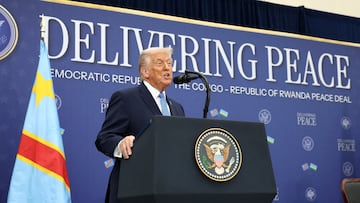
No one has been more vocal about the wars that are raging around the world than Donald Trump. The US President even sees himself as a self-styled “president of peace”, acting as a mediator in the Russia-Ukraine conflict and jokingly quipped that when it comes to restoring peace, he is “averaging about a war a month”.
✅8 wars ended in 8 months
— Department of State (@StateDept) December 3, 2025
✅America First policies
✅Respect on the world stage pic.twitter.com/hhWHgDHGNd
Back in August the president said he is not sure of the true figure, but thinks he has been instrumental in ending six wars. More recently, that number has grown to eight.
During his Inaugural Address in January, Trump exclaimed: "My proudest legacy will be that of a peacemaker and unifier. That’s what I want to be: a peacemaker and a unifier," then went on to add, “Our power will stop all wars and bring a new spirit of unity to a world that has been angry, violent, and totally unpredictable”.
This morning, the State Department renamed the former Institute of Peace to reflect the greatest dealmaker in our nation's history.
— Department of State (@StateDept) December 3, 2025
Welcome to the Donald J. Trump Institute of Peace. The best is yet to come. pic.twitter.com/v7DgkoZphn
Russia-Ukraine conflict must end
Some of the conflicts that the US President claims to have stopped were short, lasting just a few days before escalating out of control but others, such as the Russia-Ukraine war have dragged on for years. Trump wants to see a solution in the region as too many lives have already been lost on both sides.
What started out as what Vladimir Putin described as a “military operation” is now approaching its fourth year and has claimed hundreds of thousands of lives. British intelligence estimates around a quarter of a million Russian fighters have been killed (152,000 deaths have been verified by other sources such as the BBC - excluding recruits from Donetsk and Luhansk). Ukrainian forces have also suffered massive losses - anywhere from 80,000 to 150,000, depending on who you want to believe.
"...I look forward to hopefully meeting with President Zelenskyy and President Putin soon, but ONLY when the deal to end this War is FINAL or, in its final stages. Thank you for your attention to this very important matter, and let’s all hope that PEACE can be accomplished AS… pic.twitter.com/FzlAtbpNPg
— The White House (@WhiteHouse) November 25, 2025
Trump has been acting as a negotiator in ending the war, hosting Ukraine President Volodymyr Zelenskyy at the White House’s Oval Office in February but the meeting ended without a resolution. He is reported to have held numerous phonecalls with Putin and sent Special Envoy Steve Witkoff and Jared Kushner to Moscow to discuss a deal face to face with the Russian president.
But negotiations with both sides to reach a ceasefire have been frustrating and the conflict continues.
Last week in Washington D.C., Trump oversaw the signing of a peace agreement to end another long-standing conflict - between the Democratic Republic of the Congo and Rwanda, hailing the deal as a “great miracle” although unfortunately, the two nations remain at war because the leading rebel coalition, the March 23 Movement, didn’t sign the agreement and they’re the ones who continue fighting.
Delivering peace and stability to the world. 🕊️ pic.twitter.com/tLZAwlHSWz
— The White House (@WhiteHouse) December 5, 2025
Similarly the five-day armed conflict between Cambodia and Thailand ended with a ceasefire accord being signed on July 28 after Trump had threatened both countries that the US would withdraw vital trade deals. But tensions have flared up again and Trump admitted that will be forced to step in again: ““I hate to say this one, named Cambodia-Thailand, and it started up today and tomorrow I’ll have to make a phone call,” he said during last night’s rally in Pennsylvania.
Ethiopia and Egypt are not strictly at war but involved in a lengthy diplomatic dispute concerning the Grand Ethiopian Renaissance Dam project. Trump addressed the issue during his first term as president and last summer stated that both nations “are friends of mine, but they happened to build a dam, which closed up water going into a thing called the Nile. I think if I’m Egypt, I want to have water in the Nile and we’re working on that”.
Middle East tension
The Trump administration helped broker a ceasefire agreement between Hamas and Israel, to end two years of hostility and thousands of deaths. Trump drew up a 20-point peace plan for Gaza which was signed off in October, with the hope of establishing a long-term peace agreement in the area.
The Trump Route for International Peace and Prosperity (TRIPP), a 32 km trade corridor through Armenian territory was part of the deal that brought Armenia and Azerbaijan to the negotiating table, and officially ending the Nagorno-Karabakh conflict, which had been going on and off since 1988.
The Twelve-Day War between Iran and Israel was just that - a conflict that lasted less than a fortnight but in Trump’s words, “could have gone on for years and destroyed the Middle East”. Washington brokered a ceasefire - and that’s exactly what was achieved, not peace.
India refuted Trump’s claims that he was behind the “full and immediate ceasefire” in their conflict with Pakistan. The US’ role was to make sure both sides remained at the table, but according to India Foreign Secretary Vikram Misri, there was no other third party involvement.
Trump and the Nobel Peace Prize
So like so much in politics, the truth often gets distorted, spun, and minor roles and deeds, mythologized, protagonists aggrandized. Leaders of seven nations: Armenia, Azerbaijan, Gabon, Israel, Cambodia, Rwanda and Pakistan have nominated Trump for next year’s Nobel Peace Prize. Will he win it? Does he deserve to win? Who knows... four US president have won the award: Theodore Roosevelt, Woodrow Wilson, Jimmy Carter and Barack Obama.
Related stories

Get your game on! Whether you’re into NFL touchdowns, NBA buzzer-beaters, world-class soccer goals, or MLB home runs, our app has it all.
Dive into live coverage, expert insights, breaking news, exclusive videos, and more – plus, stay updated on the latest in current affairs and entertainment. Download now for all-access coverage, right at your fingertips – anytime, anywhere.
Complete your personal details to comment