


Who knew? The Moon has a distinctive smell: This is what astronauts say it smelled like
Judging by the testimony of the few astronauts who have set foot on the Moon, Earth’s satellite has a particular scent.
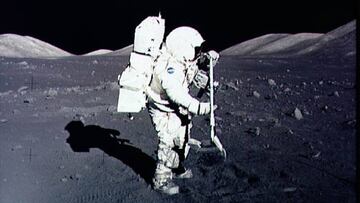

Among the exclusive club of astronauts who have landed on the Moon, there appears to be agreement: Earth’s satellite has a very particular smell.
“Spent gunpowder”
Harrison Schmitt, who walked on the lunar surface on the last of NASA’s crewed missions to the Moon, told Space.com in 2014: “Everyone’s instant impression of the smell was that of spent gunpowder.”
“Buzz” Aldrin, who was the second human ever to set foot on the Moon, added: “It was like burnt charcoal, or similar to the ashes that are in a fireplace, especially if you sprinkle a little water on them.”
Apollo astronauts hit with whiff of sticky Moon dust
Between 1969 and 1972, a total of 12 astronauts made it to the Moon’s surface during NASA’s Apollo space-exploration program - beginning with Aldrin and Neil Armstrong’s historic lunar landing 56 years ago this week.
Although Apollo astronauts could not smell their surroundings as they explored the almost-atmosphere-less Moon in their airtight spacesuits, they were able to sample the satellite’s distinctive odor once back inside their lunar module.
Removing their helmets in the pressurized module’s breathable conditions, they encountered the smell given off by the Moon rocks they had collected - and by the dust that covers the lunar surface.
“Clung stubbornly to our suits”
Described by Armstrong as “very, very fine-grained” during his Moon walk, the dust is also highly sticky, so plenty of it made it back into the lunar module.
Gene Cernan, Schmitt’s commander on the final Apollo mission 53 years ago, wrote in his 2000 autobiography that Moon dust “clung stubbornly to our suits, visors, gloves and tools as if by magnetic attraction”.
Cernan recalled “whacking at the stuff with no result” as he attempted to remove the dust from his suit and equipment.
It appears, however, that the gunpowder-like lunar scent does not survive the 240,000-mile journey back to Earth.
“The smell was gone”
In his 2019 book One Giant Leap: The Impossible Mission that Flew us to the Moon, the space historian Charles Fishman explains that rock and dust samples were sealed up in boxes and transported home for inspection by NASA specialists.
But “by the time the Moon rocks and dust got back to Earth - a total of 842 pounds from six lunar landings - the smell was gone,” he reveals.
Fishman adds: “Scientists who have studied the rocks and dirt and handled them and sniffed them say they have no odor at all.
“And no one has quite figured out what caused it, or why it was so like spent gunpowder, which is chemically nothing like Moon rock.”
Related stories


Get your game on! Whether you’re into NFL touchdowns, NBA buzzer-beaters, world-class soccer goals, or MLB home runs, our app has it all.
Dive into live coverage, expert insights, breaking news, exclusive videos, and more – plus, stay updated on the latest in current affairs and entertainment. Download now for all-access coverage, right at your fingertips – anytime, anywhere.
Complete your personal details to comment