

Sucker Punch
Ghost of Yotei: the impressive path of vengeance
Sucker Punch turns us back into ghosts ready for combat.
It’s easy to get lost in beautiful landscapes and thirst for revenge. Both look impressive, striking, and imposing from afar. As we get closer, we can tell whether we’re ready for what lies ahead or not. After several years, Sucker Punch takes us back to ancient Japan to become ghosts once again. This time, hundreds of years in the future and in a completely new setting, we must avenge our family and, along the way, find peace with our lost youth. This is Ghost of Yotei.
Ghost of Yotei is an open-world action-adventure game starring Atsu, a young orphan who, after 16 years of surviving and perfecting her combat skills, returns to Ezo, now known as Hokkaido, in search of the Yotei Six, a group of outlaws led by Saito who murdered her family. As with any good revenge story, this one won’t be quick and easy. Atsu will have to find information on where each member of this group is, help people (for a price), and continue training in combat techniques, learning to use more weapons that will bring her closer to her goal.
Revenge is never a straight line; it’s a forest
Throughout the game, Atsu will travel across Ezo in search of the Yotei Six, on an adventure that will take her to small villages and involve a whole range of activities to improve her skills. Exploration flows naturally: you can ride your horse and choose your destination freely, or use your spyglass to find points of interest around you. From finding shrines to access new skills and hot springs to increase your health to finding pillars dedicated to people who have faced Saito. Along with this, there will also be the opportunity to hunt for bounties, facing assassins and thugs in different regions to earn money, or simply discovering the stories and mysteries that surround the island.
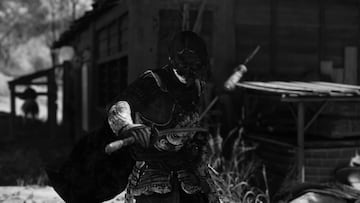
The place and time in which Ghost of Yotei takes place are unique. In 1603, the island of Ezo was still very isolated from what was happening in the Tokugawa shogunate, and throughout the story we see the political conflict between its inhabitants and the “main island,” while the indigenous peoples of these lands are displaced. The story places us in a setting that seems to come straight out of a western, but it is still a story that presents the classic elements of that moment in Japan.
Part of the gaming experience involves reaching new areas in search of one of the members of the Yotei Six, investigating the situation, meeting a master who teaches you how to use one of the different weapons in the game, and completing missions that help us get closer to our goal. We encounter moments in the story that have good twists and turns and all the possible archetypes and tropes that we can find in a story of revenge and samurai, making the story very fluid and entertaining. Here, we feel freedom that we didn’t have with its predecessor, Ghost of Tsushima, and although it doesn’t feel as linear as the previous installment, there is still a certain rigidity in how we progress.
Among swords
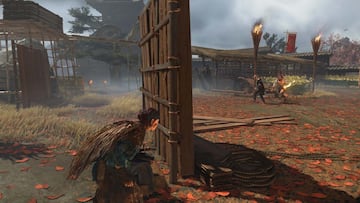
Combat is one of the most important elements of the game, and as we progress through the story, it becomes more and more complex. While Atsu starts out mastering the katana, this can be expanded to a more interesting range, from other types of swords, spears, bows, and firearms and explosives. The combat system is striking, and switching to a different type of weapon gives you an advantage, meaning that your attacks are not just simple button presses but require real attention to the enemies you are facing.
Added to this is the parry and fatigue system. Atsu can deflect or dodge enemy attacks, as long as you have the precision to do so. There will be enemy attacks that, if parried at the right moment, will leave them completely open to our attacks, while there will also be moves that can only be dodged. Although I must admit that at first the combat felt a bit strange, over time I managed to master it well.
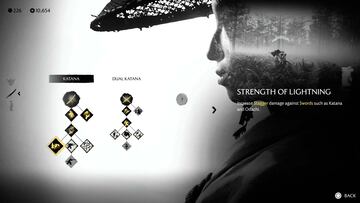
It’s also important to talk about spirit. Above our energy bar, we’ll have spheres that we’ll fill as we fight. These will allow us to perform different special attacks or recover our health. Also, when we’ve performed a certain number of attacks without being hit, we can unleash our fighting spirit to strike fear into our enemies and eliminate them more easily.
An island full of life
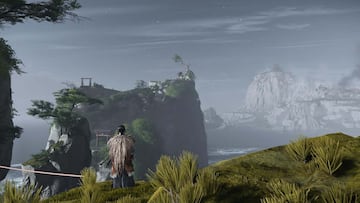
Ezo is one of the most impressive settings I have ever seen in a video game. Although it appears empty, considering that we are not going to see a big city and that it is a territory still far from being developed, there is a lot to do and see. One of the main methods of transportation is our horse, which will help us move more easily around the island, with the fields of flowers serving as a boost to move faster.
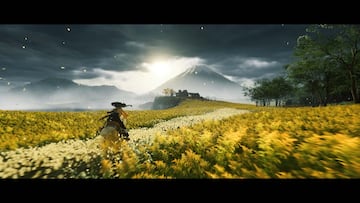
On the other hand, we have the landscapes and the different spaces throughout the map. One of the activities that allows us to capture all of this is through small painting sessions that help us capture the different landscapes of the island, from beaches to forests, mountains, and trees.
But just as there is flora and fauna that inhabits our surroundings, we will also have the pleasure of meeting people who are willing to help us in our mission. Along the way, Atsu will meet new characters who will become part of his “wolf pack.” From merchants and manufacturers to teachers who teach you how to use new weapons. You can invite many of them to your camps if you are far from where they are located, so you can buy items or work on weapons or upgrades as needed.
A technical work
One of the areas where Ghost of Yotei really stands out is in its technical aspects. Where the game shines most is in its visuals. Each of the regions of Ezo is visually stunning. The lighting effects are noticeable at every step of the game, with aspects such as wind and weather changing what we see on screen. This, coupled with an extremely clean HUD, allows us to fully appreciate the beauty of this world, where nature reigns supreme.
This is further enhanced by the photo mode, which offers several options for taking photos that look even more impressive than what we see on screen. From changing filters, lenses, and positions to visual effects such as weather, light, and more. I rarely return to photo modes, but in this case, I was more than amazed.
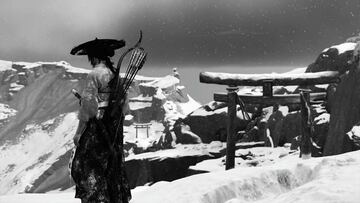
The visual aspect is accompanied by two new features. While its predecessor impressed us with Kurosawa mode, which turned the story into a samurai film by director Akira Kurosawa, Ghost of Yotei adds a couple of new modes to give the game a different tone. Takashi Miike mode, inspired by the Japanese director’s excessive use of blood, gives combat just that: more blood, more gore, and more up close. It makes combat a little more complex due to the proximity, but over time you get used to the camera and the extra gallons of blood that appear when you cut or mutilate. On the other hand, there is Shinichirō Watanabe mode, which does not affect the visuals but adds lo-fi music to our adventure. This last mode was quite strange to use, as I sometimes feel that it breaks the mood or the situation. I tried it for the first time while accompanying a monk who needed help getting to a certain point, and although the music is quite good, it really broke the solemn and philosophical moment that was happening. It’s music for when we’re wandering around the world, as in another context, it feels a bit out of place.
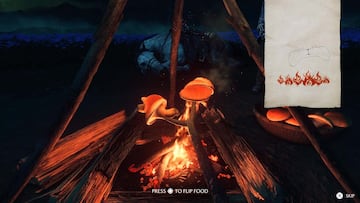
The game showcases the power of the PlayStation 5 and makes great use of not only the console but also the DualSense controller. Activities such as lighting a campfire and cooking at your campsite use the controller as a tool at your disposal, while the touchpad sometimes becomes a canvas where your finger becomes the brush. These are aspects that give the controller extra meaning and make it feel good.
In addition, there are moments when we can “control Atsu from the past.” At certain points on the map, we can embark on adventures where we travel back to Atsu’s youth simply by pressing the touchpad. There aren’t that many places, but it’s an interesting exercise that initially serves as a tutorial but later in the story helps to connect dots in the game’s narrative.

Ghost of Yotei is an impressive work from Sucker Punch, a step up from Ghost of Tsushima, thanks to a more open and free world. It is a technical and artistic triumph: visually stunning, full of life, and with deep and challenging combat. However, despite a solid narrative and memorable twists, the progression retains a certain rigidity that prevents the experience from feeling as innovative as it could. Even so, it is a title that shines for its ambition and execution, consolidating Sucker Punch as one of the studios that best knows how to capture the essence of feudal Japan in the interactive medium.
Follow MeriStation USA on X (formerly known as Twitter). Your video game and entertainment website for all the news, updates, and breaking news from the world of video games, movies, series, manga, and anime. Previews, reviews, interviews, trailers, gameplay, podcasts and more! Follow us now!