


Tribute Games
Scott Pilgrim EX: the spirit of the graphic novel lives on amid fists, pixels, and robots
The new installment expands the universe created by Brian Lee O’Malley with fluid combat, revamped music, and constant fan service.
Scott Pilgrim is a hero who left his mark on an entire generation. The fact that we are still talking about this work more than 16 years after the end of Brian Lee O’Malley’s graphic novel series, and of course his live-action film, speaks to the cultural legacy he has left behind. With that comes a certain level of nostalgia, evoked by a work that already looked to the past. When one thinks of this universe, the video game that was released alongside the film comes to mind, which disappeared for many years until returning in a complete version just a few years ago. Now, with the arrival of Scott Pilgrim EX, these characters return once again to immerse us in nostalgia.
Big Trouble in Little Toronto
Scott Pilgrim EX is a beat ‘em up that brings back the province’s best fighter, Scott Pilgrim, a few years after the end of the graphic novel. The story follows Scott, who during a rehearsal with Sex Bob-omb sees his bandmates—Stephen Stills, Kim Pine, Young Neil, and Knives Chau—get kidnapped by a robot identical to him: Metal Scott. To rescue them, Scott and Ramona must turn to unexpected help, including former members of the League of Evil Exes such as Lucas Lee, Matthew Patel, Roxie Richter, and Gideon, as well as Robot-01.
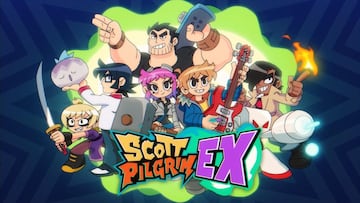
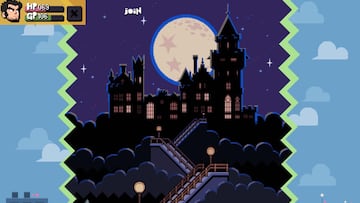
Although the game is based on the classic beat ‘em up structure, the experience is mixed with Metroidvania-style elements. Beyond advancing by beating up any enemies that cross your path until you reach a level boss and move on to a new stage, the game takes you on a tour of iconic locations in Toronto that we know from the comics. We’ll visit Scott and Wallace’s loft, various shops, Ramona’s house, the Chaos Theatre, the film studio, and other locations. The story guides us through these spaces as we find clues and complete missions to rescue our friends and find out who is behind it all.
While this approach is interesting, it also makes the map feel smaller. Instead of extensive exploration, the experience becomes more of a constant back-and-forth between certain points as the missions progress, moving away somewhat from a Metroidvania in every sense. As we progress, we also obtain special items and songs that allow us to open and access new portals, but beyond that, the possibilities for additional exploration are limited.
Reformed enemies
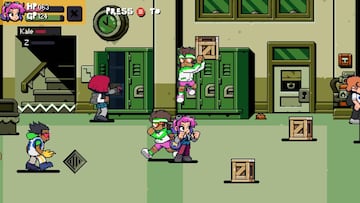
One of the first details to note is that each of the seven playable characters feels different. While there are standard moves—strong and weak attacks, special abilities, grabs, and more—each character has their own unique characteristics. Scott is a balanced character, while Lucas Lee is slow due to his build but extremely powerful. Ramona can attack and escape quickly, while Matthew uses his abilities to keep his distance. As we progress, we will level up and strengthen our character. The moves are flashy and full of references, not only to the original work—such as Ramona’s “glow” turning into an attack—but also to other video games. The combat feels fluid and varied, with enough options to prevent the experience from being reduced to simple button mashing. Along with attacks, we’ll also have the option to call on a support character, ranging from Wallace making enemy attacks do less damage, to Gideon (the cat, not the ex) flying like Nyan Cat, or calling on the Katayanagi Twins to heal us a little with their music.
Added to this is a huge variety of items that can be found in the environment: stones, bottles, bats, giant hammers, boomerangs, yo-yos, bombs, and practically anything else imaginable. There are also nods to other video games, such as the appearance of the Belmont family’s whip. In stores, you can buy food, accessories, and badges that grant upgrades, either by increasing stats or unlocking abilities. One thing to note is that once purchased, these items can be equipped even if you decide to switch characters.
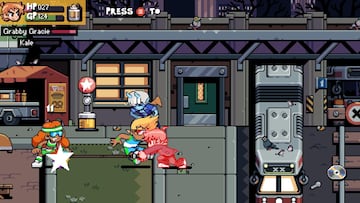
In terms of aesthetics, Scott Pilgrim EX boasts simply spectacular pixel art. The design of characters, enemies, and NPCs is full of detail and personality, making it one of the most carefully crafted aspects of the game. Some backgrounds and buildings also stand out for their level of detail, and there are even a few cameos from other works by Bryan Lee O’Malley—a wonderful nod to 'Seconds.' However, not everything is perfect: in certain scenarios, elements such as boxes or other platforms look so flat that it is unclear whether they can be used to jump on. One example is Scott and Wallace’s “loft,” where the bed looks like a visual obstacle, although in practice you can walk through it without any problems. Technically, the game remains fluid even when there are many enemies on screen, avoiding performance drops.
Another great success is the music, with Anamanaguchi returning to create the soundtrack. Despite the passage of time, it is interesting that the band has composed completely new music, without reusing tracks from the game released 16 years ago.
Even so, Scott Pilgrim EX has some details that need to be corrected. During the game, progress can be lost due to glitches that prevent missions from being completed, forcing the player to restart. There are also bugs where some enemies become immobile or stuck when trying to attack. Although these issues can be frustrating, they are flaws that could be fixed with patches, providing a more polished experience.
Scott Pilgrim EX is a love letter to a work that never ceased to be relevant to an entire generation. Its commitment to combining the classic essence of beat ‘em up with modern elements, outstanding visuals, and a completely new soundtrack manages to capture the spirit of the universe created by Brian Lee O’Malley. Although some technical issues and design decisions limit its potential, the game achieves something fundamental: it makes returning to Toronto feel familiar, fun, and full of nostalgia, proving that Scott Pilgrim and company still have a lot to offer.
Follow MeriStation USA on X (formerly known as Twitter). Your video game and entertainment website for all the news, updates, and breaking news from the world of video games, movies, series, manga, and anime. Previews, reviews, interviews, trailers, gameplay, podcasts and more! Follow us now!