

Huawei drops out of the global Top 5 in smartphone sales
The Chinese phone giant loses its leadership position following US restrictions; Samsung and Apple retake the lead in a market undergoing readjustment.

The global smartphone market has changed dramatically. Huawei, which just a couple of years ago was firmly among the top three and even led the world, has plummeted. The Chinese manufacturer has dropped out of the select group of the top five global smartphone sellers, a blow that, although predictable, marks a milestone in the industry and underscores the direct impact of the sanctions imposed by the U.S. government.
This decline was clearly evident during the first quarters of the year, according to reports from specialized consulting firms such as IDC and Omdia (formerly Canalys). While the market in general experienced an upturn in global shipments, Huawei was unable to capitalize on this trend, lagging behind its direct competitors.
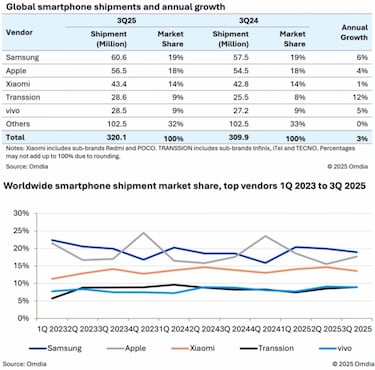
Which brands currently occupy the top spots in the smartphone market?
The reconfiguration of the global sales landscape is remarkable. In its most recent report, consulting firm Omdia points to Samsung’s supremacy, regaining its market throne with a 19 percent share. The South Korean firm’s strategy, focused on a wide range of prices and models in the Galaxy series, demonstrates its resilience.
Apple follows closely behind, experiencing significant momentum, especially after the launch of its new iPhone 17 line. The rest of the Top 5 is made up of emerging and established Chinese manufacturers, which have been able to take advantage of the void left by Huawei:
- Xiaomi
- Transsion (Tecno, Infinix e Itel)
- and Vivo
These three Asian brands are showing remarkable year-on-year growth, driven by strong demand in Asia and aggressive expansion in key markets in Europe and Latin America, offering devices with excellent features at competitive prices.
The impact of the trade war on Huawei
Huawei’s decline is not due to a lack of quality in its products, but rather to geopolitical issues. The US government’s decision to add the company to its “blacklist” for alleged links to Chinese intelligence triggered a blockade on access to essential technologies.
The ban on working with chip manufacturers and the interruption of access to Google Mobile Services (GMS) for its new smartphones were the triggers that severely affected Huawei’s ability to compete outside China.
Without Google services, which are essential for most Western users, the value proposition of Huawei’s new devices weakened considerably. In addition, the sale of its sub-brand Honor at the end of 2020 also contributed to the reduction in its total shipment volume, compounded by the fact that its alternative operating system (HarmonyOS) may not be catching on in markets outside China.
Related stories

Follow MeriStation USA on X (formerly known as Twitter). Your video game and entertainment website for all the news, updates, and breaking news from the world of video games, movies, series, manga, and anime. Previews, reviews, interviews, trailers, gameplay, podcasts and more! Follow us now!
Complete your personal details to comment