

Prince Rupert’s drop: these unusual glass structures are so strong that they can destroy a hydraulic press
Although they were discovered in the 17th century, Prince Rupert’s drops remain a fascinating scientific curiosity to this day.
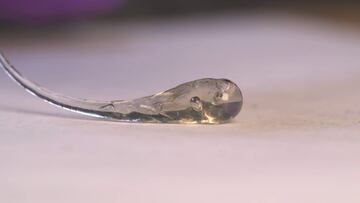

Prince Rupert’s drops are fascinating glass structures that challenge our understanding of physics. Despite their fragile appearance, these small spheres with tails, whose shape resembles that of spermatozoa, possess extraordinary strength, being able to withstand such extreme pressures that they can even destroy a hydraulic press. Their uniqueness lies not only in their hardness, but also in the existence of a single weak point that can cause the structure to collapse almost instantly and completely, further challenging our understanding of how this object can be so resistant and yet so fragile. Their manufacturing process makes them a perfect example of how the properties of materials can be drastically altered depending on the shape they take. In this text, we will explore how these droplets are created, what makes them so special, and why their study remains relevant today.
What are Prince Rupert’s drops, how are they created, and what properties make them so special?
Prince Rupert’s drops are made through an extremely rapid cooling process, dripping molten glass into cold water. This rapid cooling turns the outside of the drop into a solid layer that hardens almost instantly, while the inside remains hot and molten for a short period of time. This temperature difference creates large compressive forces on the outside, while tensile forces are concentrated on the inside. The combination of these internal stresses gives the glass impressive strength, capable of withstanding up to 50 tons per square inch at some points on the drop, giving it a hardness comparable to that of some steels. In fact, when subjected to strength tests in a hydraulic press, these drops do not yield, but instead are capable of destroying the presses that attempt to test their strength.
The most intriguing thing about Prince Rupert’s drops is the “duality” of their extreme strength and fragility. While the exterior of the drop can withstand immense pressure, any damage to the tail, the thinnest part of the object, can cause the drop to collapse almost instantly at speeds that can exceed 3,000 miles per hour. This is due to a peculiar physical phenomenon: the compressive stresses generated on the outside of the drop are balanced by the tensile forces inside it; when a crack occurs, these forces are no longer in equilibrium, and the structure collapses violently and explodes due to the massive release of energy.
Related stories
While ordinary glass is fragile and breaks easily, the particular design of these drops, with their thin tail and robust body, allows the distribution of internal stresses to make them much more resistant than traditional glass. This is a very interesting example of how manufacturing techniques have dramatically affected the properties of glass by turning it into a type of tempered glass. This principle is also a clear example of how the geometry and structure of an object can modify the properties of the material.
Follow MeriStation USA on X (formerly known as Twitter). Your video game and entertainment website for all the news, updates, and breaking news from the world of video games, movies, series, manga, and anime. Previews, reviews, interviews, trailers, gameplay, podcasts and more! Follow us now!
Complete your personal details to comment