

Saros: First Impressions – A Strange Ballet on a Strange Planet
A roguelike where you always come back stronger.

The core of roguelikes is simple: die, learn from your mistakes, and try again. With the launch of the PlayStation 5 five years ago, Housemarque introduced Returnal, a game that not only showcased the power of Sony’s new console but also pushed the genre to its limits. After several years working on their next project, we were introduced to Saros a few months ago—and from its very first trailer, it raised more questions than answers.
Is Saros a Returnal 2? How do you follow up a game that once felt nearly perfect? To find out, I traveled to Helsinki, Finland, where I had the opportunity to get hands-on with Housemarque’s new project, play its first three hours, shoot, die, try again, and see what this mix of striking weaponry, cosmic horror, and roguelike design really has to offer.
Beyond the Bullets
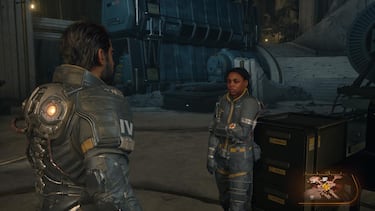
Saros puts players in the boots of Arjun Devraj, a soldier for the Solaris corporation who arrives on the planet Carcosa with his squad to investigate the disappearance of the first colony sent to extract an unknown material. The mystery escalates quickly: the planet is in a constant state of flux, and something appears to be affecting the minds of those who inhabit it. Adding to the unease is a disturbing phenomenon—every time Arjun dies during an expedition, he awakens back at his base, The Passage, while the planet completely reconfigures itself.
The experience of Saros is built around a key concept that creative director Gregory Louden explained during the presentation. For him, the game goes beyond being a traditional bullet hell—it is a “bullet ballet.” While bullet hells are about precise movement to avoid incoming fire, a bullet ballet is about dancing through the bullets, absorbing them, and turning them to your advantage. It may sound abstract at first, but once you’re in control, the idea clicks and becomes a central part of how the game is played.
Arjun’s toolkit is clear yet deep: a primary weapon, a melee attack, a lateral dash, a jump, and a shield that fully protects him but degrades with use. That shield is where the bullet ballet concept truly comes into play, as it allows players to activate secondary abilities by interacting with enemy fire. Over the course of a run, Arjun gains access to technology that lets him charge a beam from his arm. This attack is devastating and crucial both for clearing groups of smaller enemies and weakening larger threats. More than once, my approach shifted from “eliminate everything as fast as possible” to something more deliberate—leaving enemies alive specifically to exploit their gunfire and recharge this ability before moving forward.
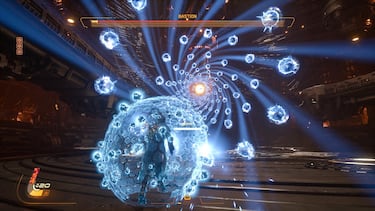
That said, not all bullets can be absorbed. As a run progresses, Carcosa’s eclipse comes into play, transforming the environment and significantly raising the tension. This event acts as a clear difficulty spike, signaling the end of a biome and symbolically hinting that darkness is closing in. Enemies become more aggressive and begin firing projectiles that not only deal more damage but also corrupt your maximum energy bar, limiting recovery until the level ends… or until the level ends you.
Carcosa itself is also a key character in Saros. The planet has a distinct aesthetic, shaped by an ancient civilization that worshipped the sun and has mysteriously vanished. Even in just three hours, the planet stood out as both violent and beautiful, constantly presenting new questions as you progress. Traversal becomes more fluid over time thanks to a network of tunnels and technology that enables teleportation.
Here We Go Again
Each run is designed to last around 30 minutes—enough time to push through Carcosa’s biomes. While you might assume these areas are procedurally generated, they are not. Instead, the studio has carefully handcrafted their variations. The biomes also retain fixed structural landmarks that gradually become familiar. This approach allows players to recognize locations and anticipate dangers without removing the sense of uncertainty that defines the genre.
One of the most notable departures from traditional roguelikes is the introduction of the material the colony was originally searching for: Lucenite. This resource enables permanent progression. Upon returning to The Passage, regardless of how a run ends, Lucenite can be delivered to Primary. This Solaris supercomputer unlocks persistent upgrades across three core pillars: health, shield, and resources. These upgrades improve survivability, but Housemarque has clearly aimed for balance between character progression and player skill. As Louden explained, the goal is for mechanical growth never to replace personal improvement, keeping the challenge intact.
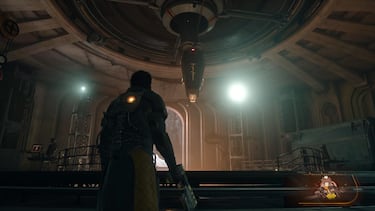
Along the way, players also encounter temporary upgrades that affect individual runs. Early on, discovering certain crystals offers limited choices, but as runs are repeated and deeper biomes are reached, the pool of options expands. That familiar roguelike feeling—choosing the best possible upgrade for your situation—starts to take shape. The same applies to weapons. A variety of assault rifles, pistols, and shotguns appear throughout a run, each with unique abilities and stats, and ultimately, their effectiveness depends on how you choose to use them.
This system also strengthens the narrative. Beyond the main storyline that reveals what is happening on Carcosa, Saros delivers its lore through optional conversations and audio logs that only appear in specific runs. The result is a fragmented narrative that slowly comes together, filling in gaps and deepening the mystery of the planet, Arjun and his team, and—most importantly—giving players a reason to return. While action is the game’s primary focus, this underlying mystery acts as seasoning for the experience. It may not be what draws players in at first, but it meaningfully enriches the whole, and in these early hours, it works as a strong hook to keep exploring.
Pushing the Hardware
After Returnal, it’s clear that Housemarque has mastered the PlayStation 5 hardware. Saros runs very smoothly at 60 frames per second, even during large-scale encounters and screens packed with projectiles. Interestingly, the few performance dips I noticed occurred during narrative sections with NPCs rather than during the most visually intense moments.
The 3D audio work is outstanding and fully envelops the experience, enhancing both the action and the cosmic horror atmosphere. The DualSense controller feels like a natural extension of the game, with every step, shot, and movement conveyed precisely through haptic feedback and adaptive triggers.
The team also applied lessons learned from Returnal to the control scheme. Subtle but effective adjustments allow players to keep their thumbs on the sticks at all times—crucial during the game’s most demanding sequences. The combination of visuals, sound, and hardware response keeps the action consistently fluid and aggressive.
This preview was played on a standard PlayStation 5, and discovering Saros this way was a standout experience. According to Louden, while the PlayStation 5 Pro version will offer additional enhancements, the goal is for the game to serve as a showcase for what the base console can do—ensuring that the experience remains true to the studio’s vision without leaving anyone behind.
Saros upholds Housemarque’s signature promise: easy to play, difficult to master. This first hands-on session makes it clear that the studio learned from Returnal and refined its approach through a different interpretation of chaos. The bullet ballet concept comes together by overwhelming the player with constant stimuli while also offering new ways to interact with that chaos and rethink forward momentum. Elements like the shield as the core of combat, Carcosa’s ever-changing nature, and the eclipse as a peak tension mechanic all reinforce a strong, clearly defined identity.
There are still many questions left unanswered—narrative, mechanical, and structural—but after this first encounter, one thing is clear: Saros is not trying to be Returnal 2. It understands what its predecessor did right and builds on the studio’s creative maturity to forge its own path.
Follow MeriStation USA on X (formerly known as Twitter). Your video game and entertainment website for all the news, updates, and breaking news from the world of video games, movies, series, manga, and anime. Previews, reviews, interviews, trailers, gameplay, podcasts and more! Follow us now!
Complete your personal details to comment